


Private Credit Pulse
BiweeklySeptember 22, 2026

Private Credit Pulse September 08, 2026

9.08PrivateCreditPulse1.jpg
9.08PrivateCreditPulse2.jpg
9.08PrivateCreditPulse3.jpg
9.08PrivateCreditPulse4.jpg
9.08PrivateCreditPulse5.jpg
9.08PrivateCreditPulse6.jpg
9.08PrivateCreditPulse7.jpg
9.08PrivateCreditPulse8.jpg
9.08PrivateCreditPulse9.jpg
9.08PrivateCreditPulse10.jpg
9.08PrivateCreditPulse11.jpg
9.08PrivateCreditPulse12.jpg
9.15AIPulse13.jpg
9.15AIPulse14.jpg
9.15AIPulse15.jpg
9.15AIPulse16.jpg
7.14PrivateCredit17.jpg
7.14PrivateCredit18.jpg

Executive Summary

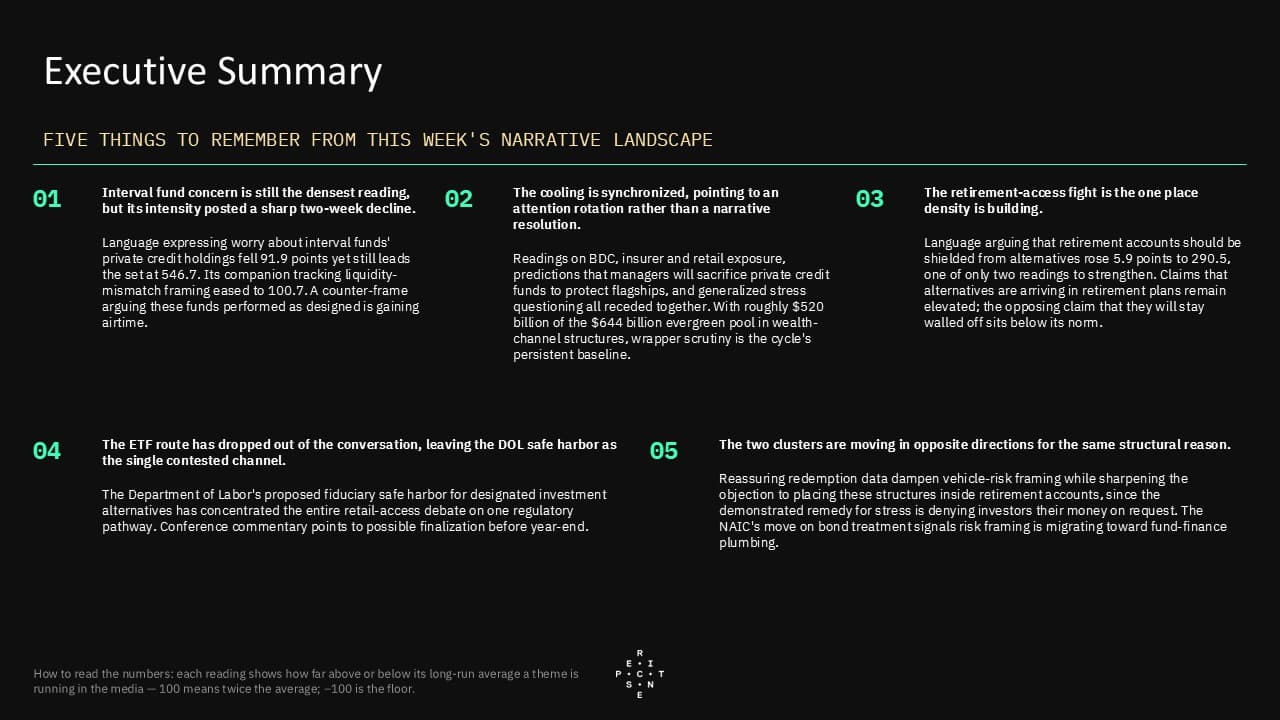
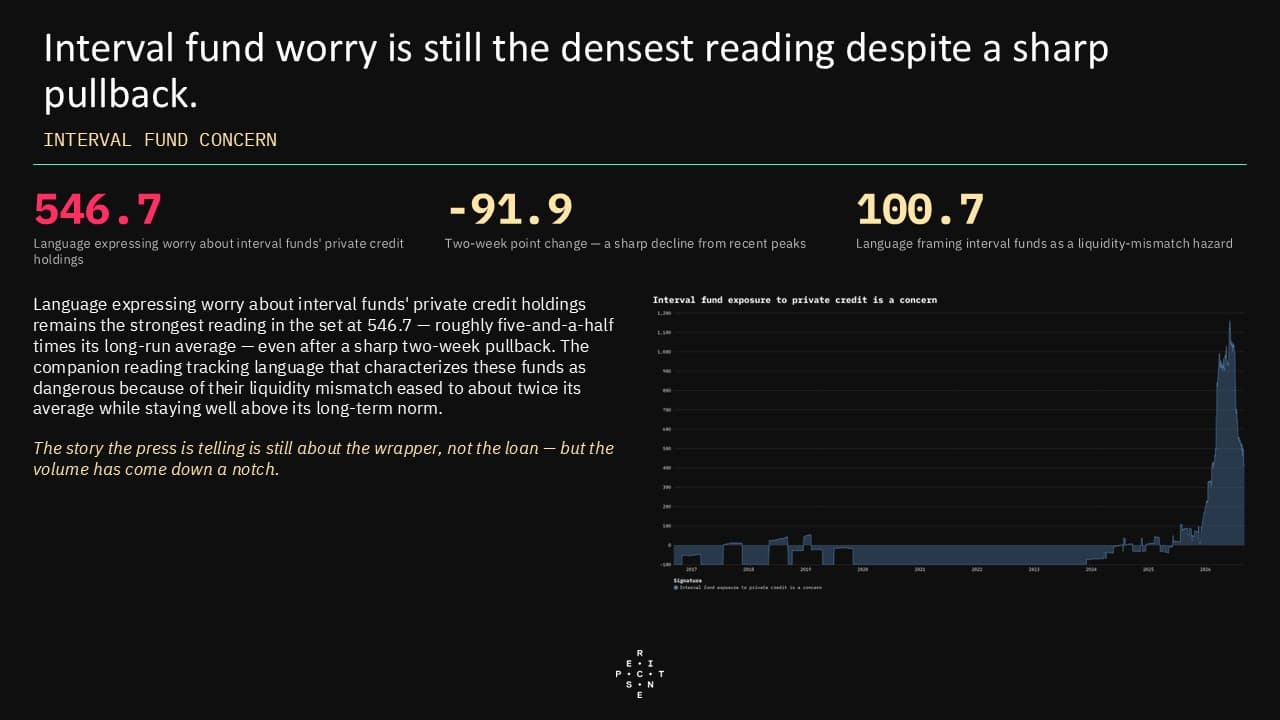
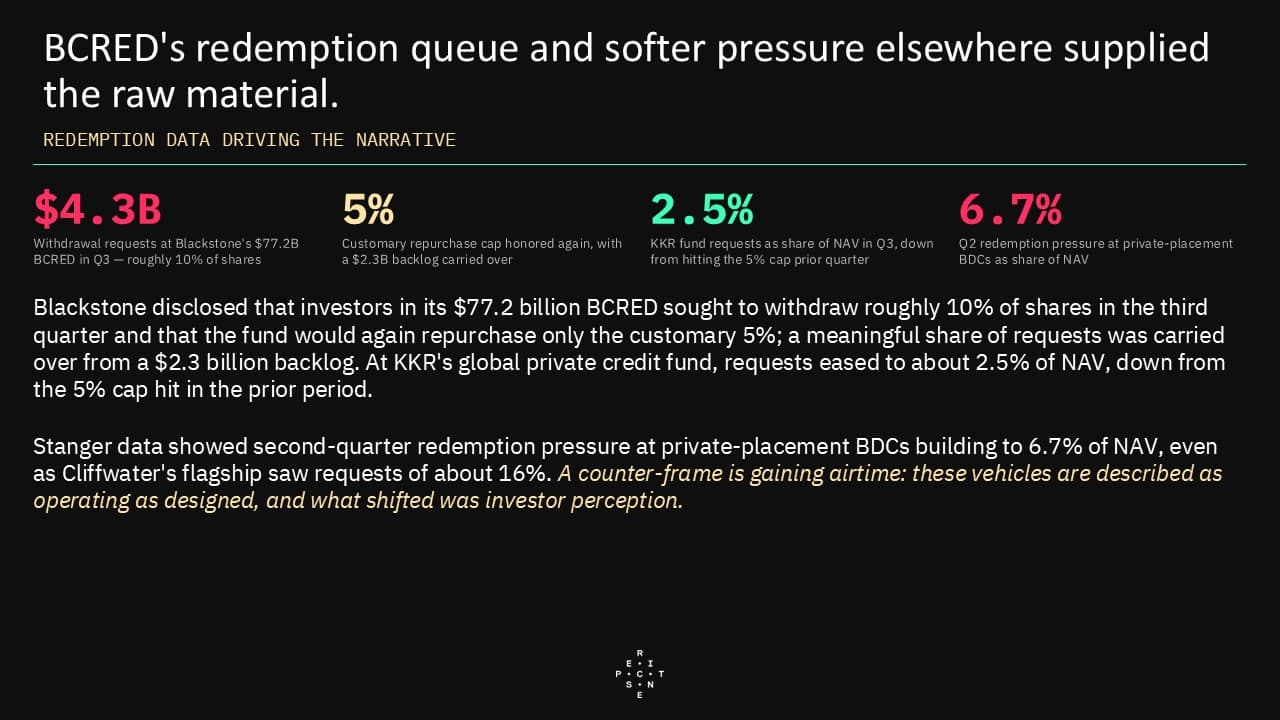
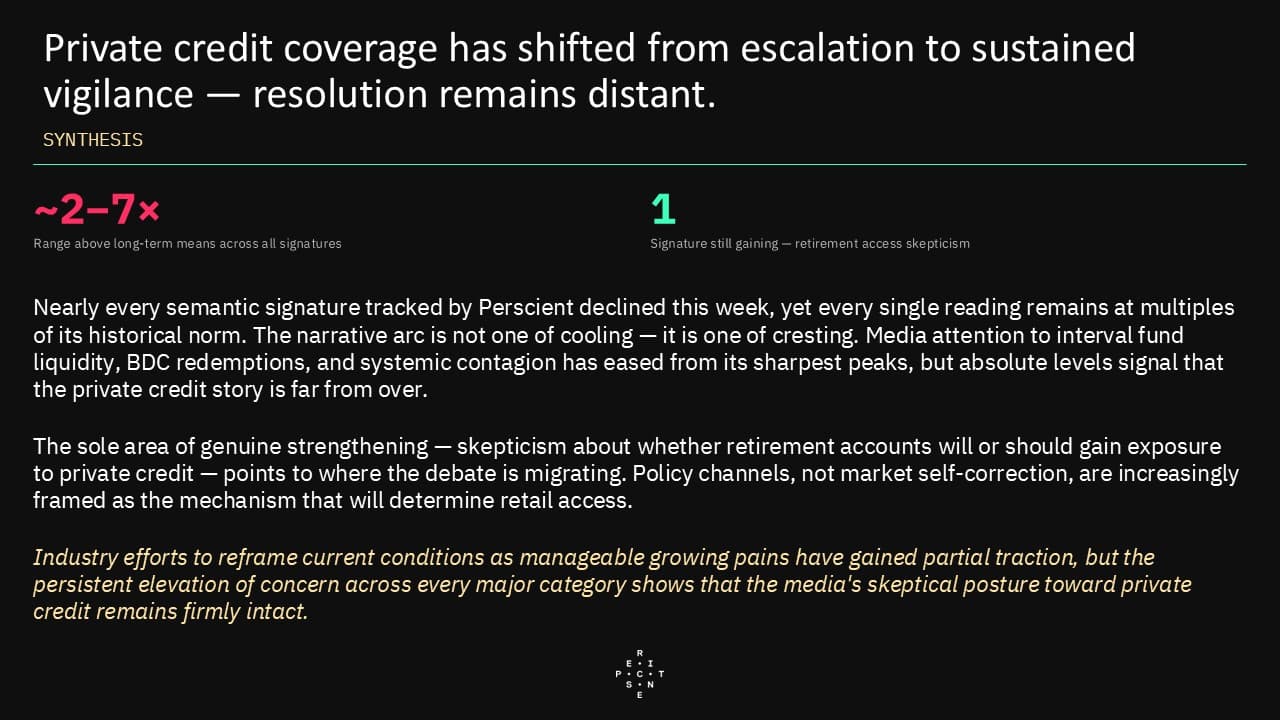
  • Coverage still fixates on the wrapper, not the underlying loan, though the heat has come off. Perscient's semantic signature tracking worry about interval funds' private credit holdings remains the densest reading in our set despite the sharpest two-week decline we measured, and its companion signature framing semi-liquid vehicles as a liquidity-mismatch hazard also eased while staying well above its long-term norm. Reporting on BCRED's carried-over redemption queue, softer requests at KKR's global private credit fund and elevated requests at Cliffwater's flagship supplied the raw material, but a counter-frame arguing that these funds performed exactly as designed — and that investor perception is what changed — is now getting airtime.
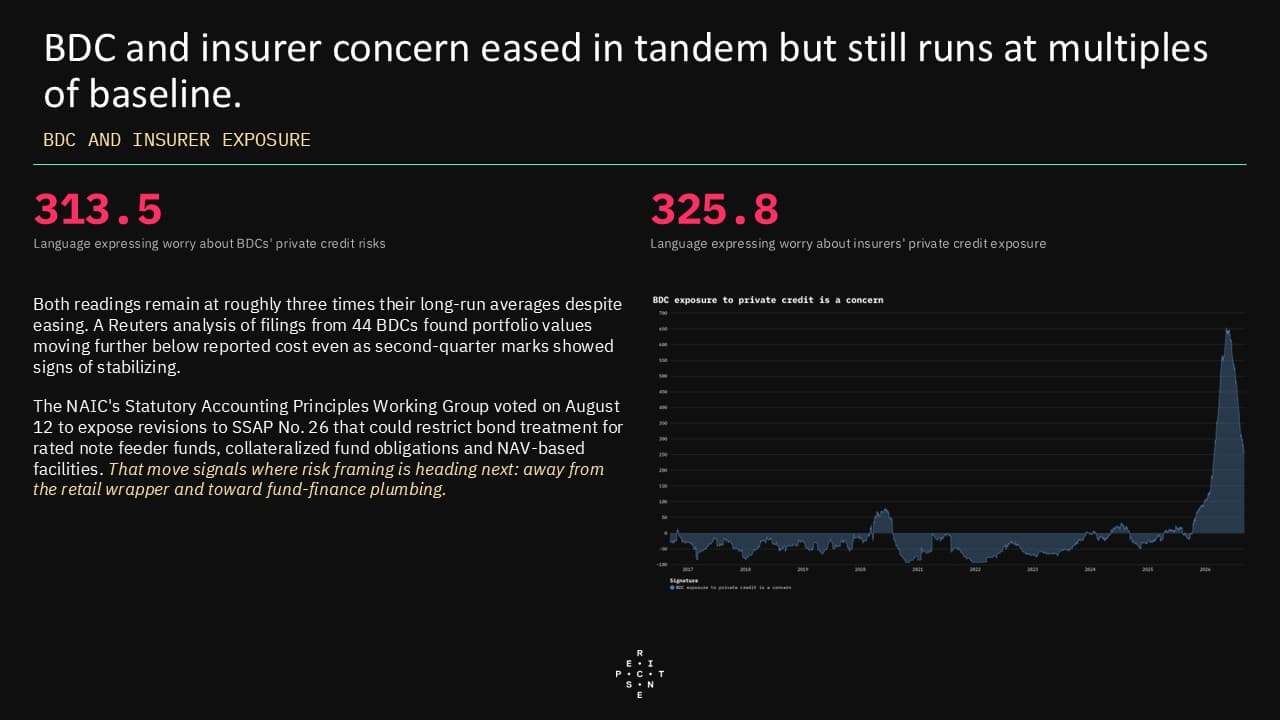
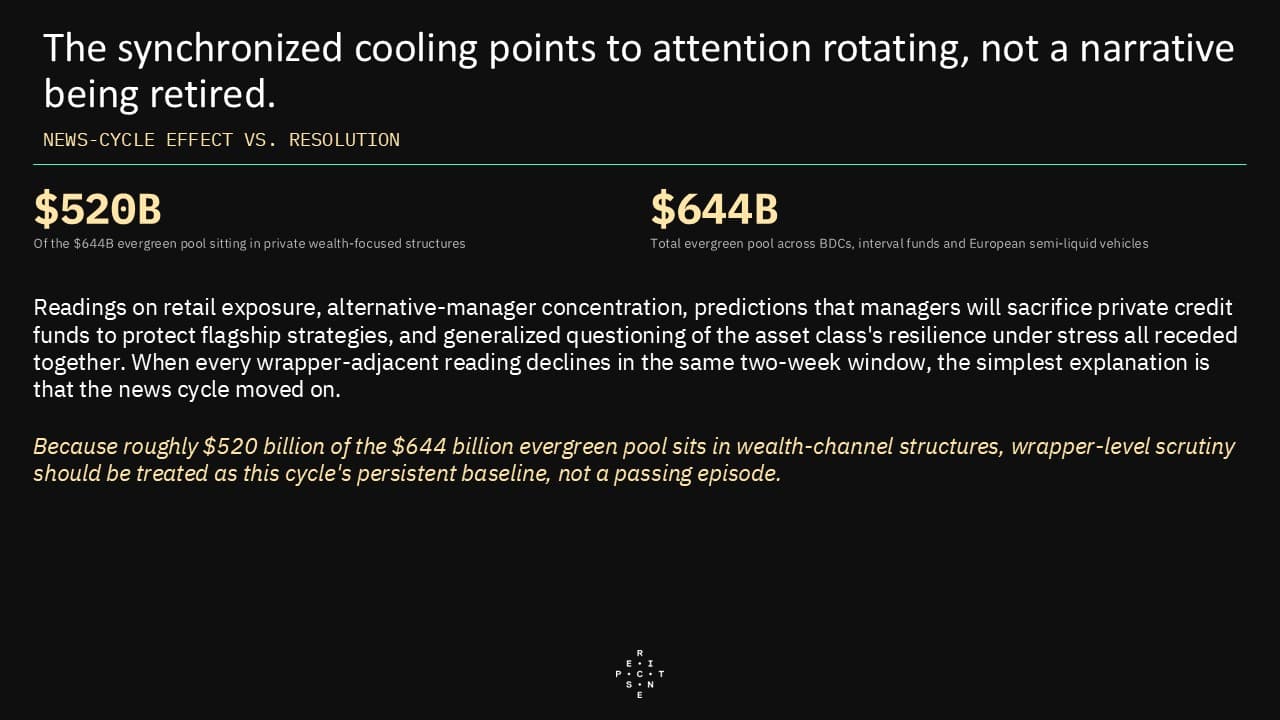
  • The cooling looks like a news-cycle effect rather than a resolution of the underlying question. Signatures tracking concern about BDC, insurer and retail exposure, predictions that managers will sacrifice private credit funds to protect flagship strategies, and generalized questioning of the asset class's resilience under stress all receded together, which points to attention rotating away rather than to any narrative being retired. Because the overwhelming majority of the evergreen pool sits in wealth-channel structures, wrapper-level scrutiny is best treated as this cycle's persistent baseline, not a passing episode.
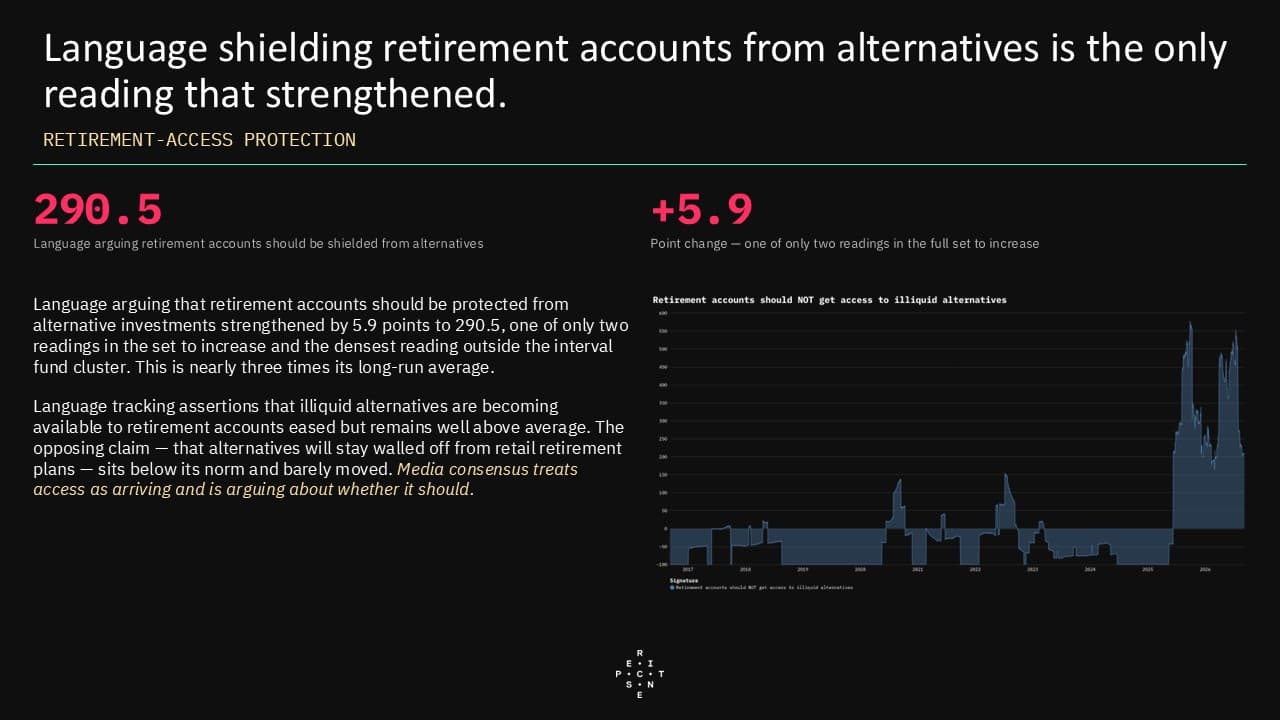
  • The access fight is the one place where narrative density is building, and it has consolidated around retirement plans. The signature tracking arguments that retirement accounts should be shielded from alternative investments was one of only two readings in the entire set to strengthen, and it is now the densest signature outside the interval fund cluster. Claims that illiquid alternatives are arriving in retirement accounts eased but remain elevated, while the opposing claim that alternatives will stay walled off from retail retirement plans sits below its norm and barely moved — media consensus treats access as arriving and is arguing about whether it should.
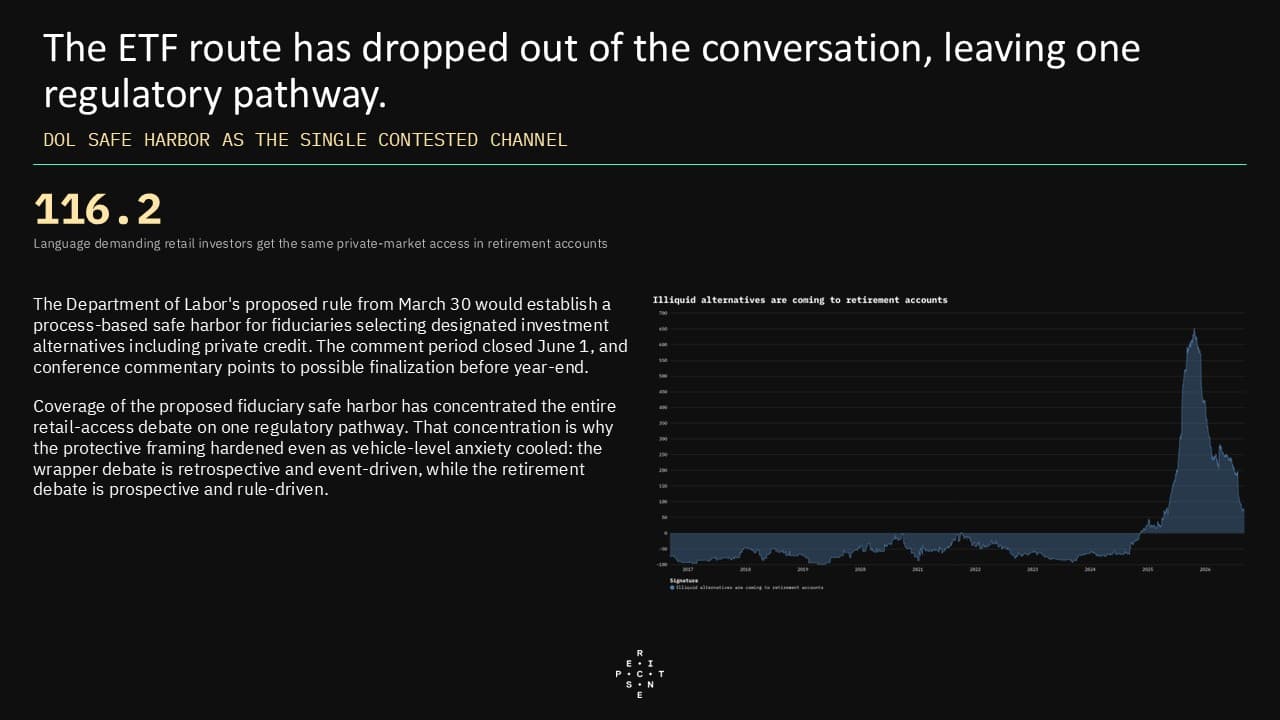
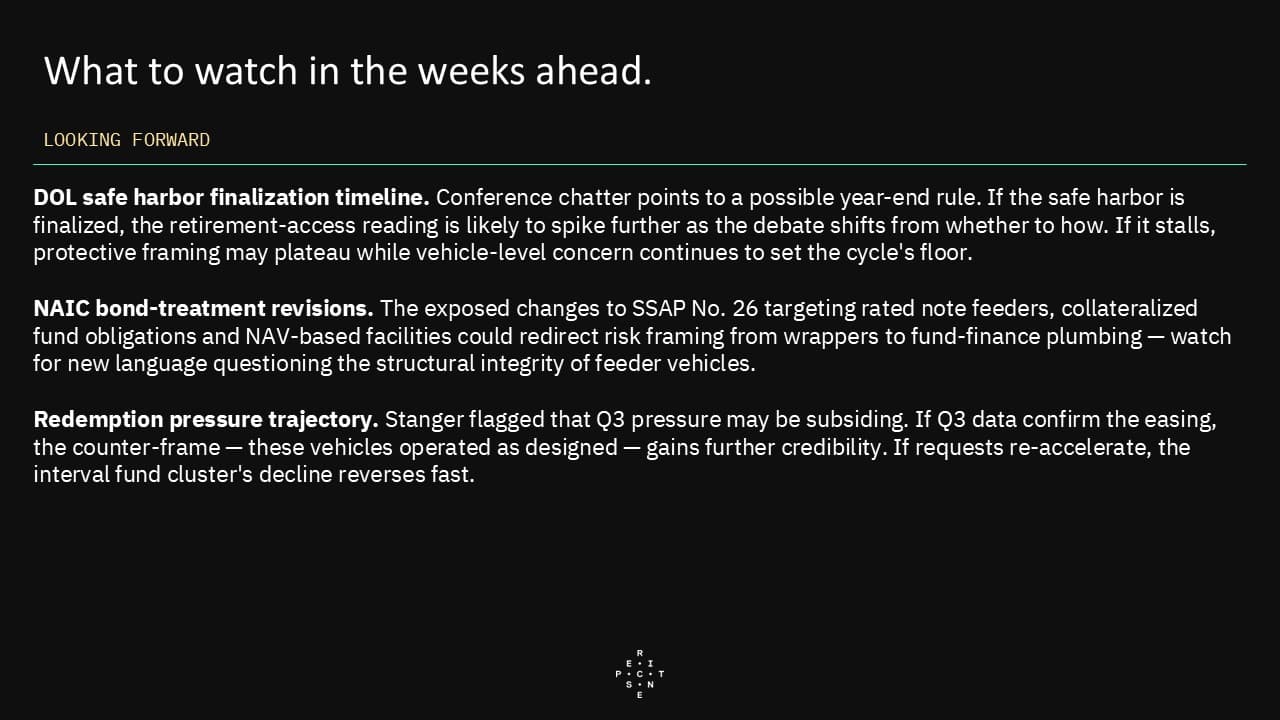
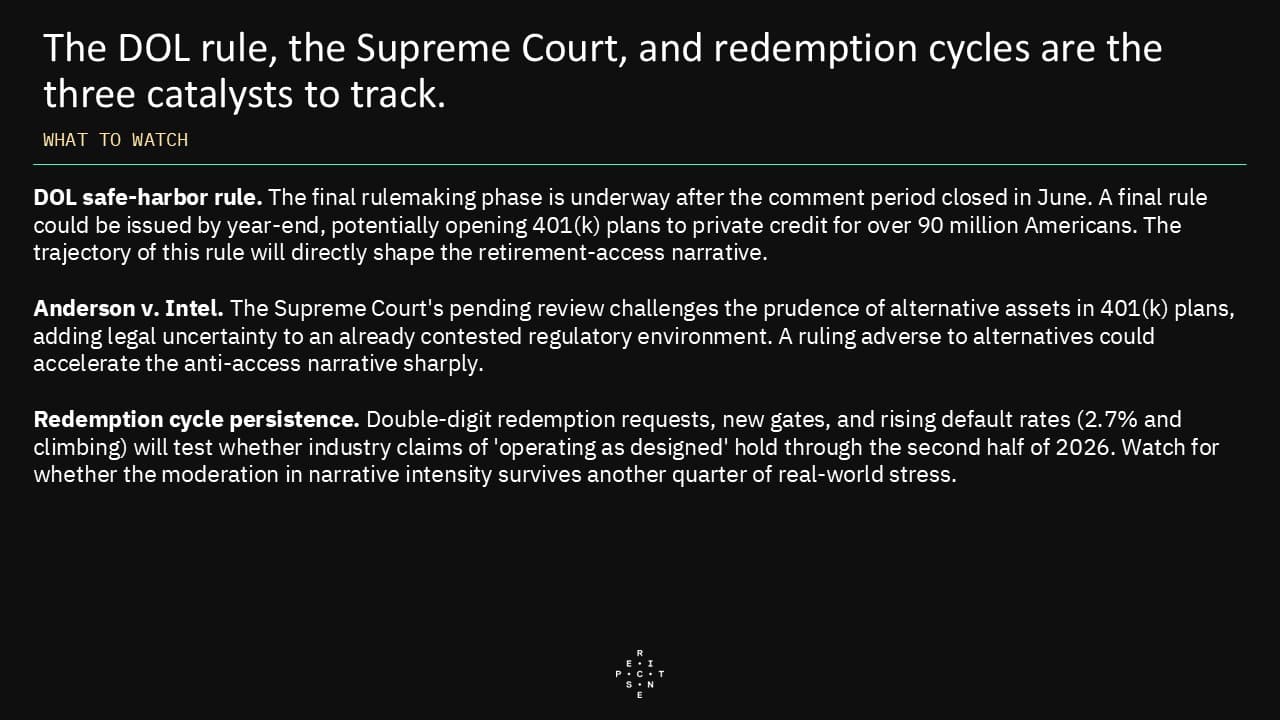
  • The ETF route has effectively dropped out of the conversation, leaving the Department of Labor's pending safe harbor as the single contested channel. Coverage of the proposed fiduciary safe harbor for designated investment alternatives, together with conference chatter about finalization before year-end, has concentrated the entire retail-access debate on one regulatory pathway. That concentration is why the protective framing hardened even as vehicle-level anxiety cooled: the wrapper debate is retrospective and event-driven, while the retirement debate is prospective and rule-driven.
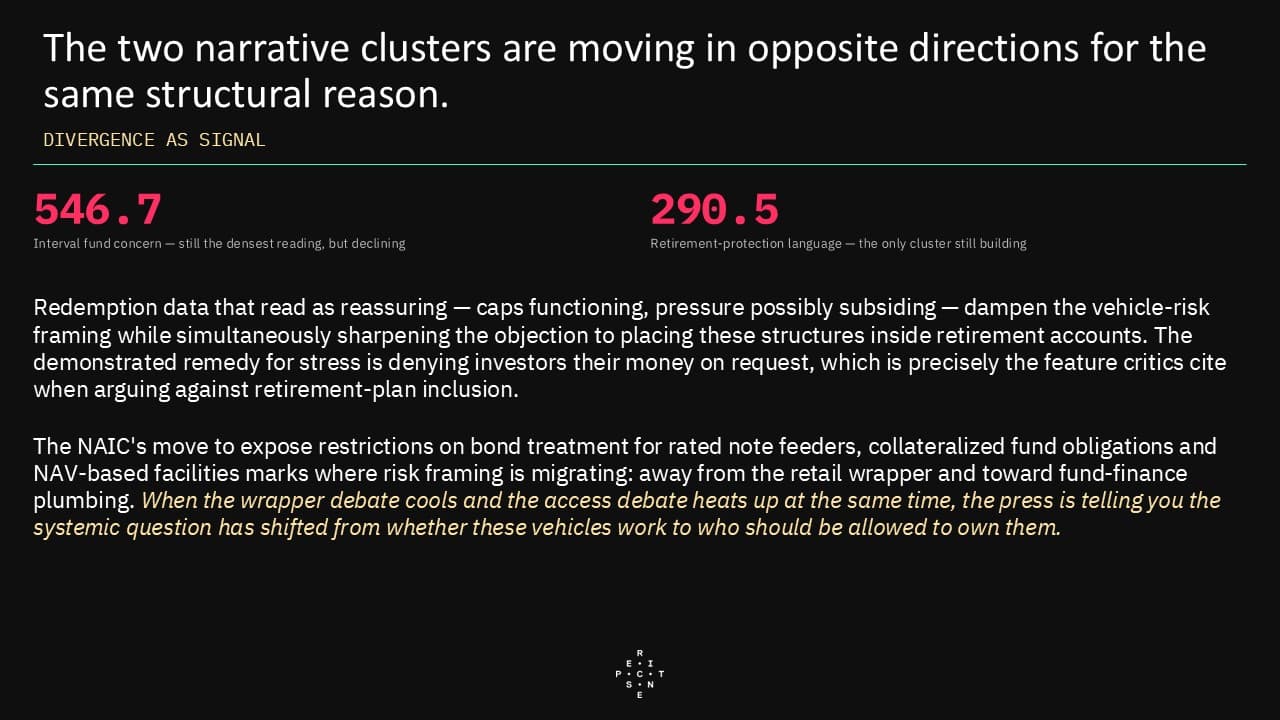
  • Taken together, the two clusters are moving in opposite directions for the same reason. Redemption data that read as reassuring — caps functioning, pressure possibly subsiding — dampen the vehicle-risk framing while simultaneously sharpening the objection to placing these structures inside retirement accounts, since the demonstrated remedy for stress is denying investors their money on request. The NAIC's move to expose restrictions on bond treatment for rated note feeders, collateralized fund obligations and NAV-based facilities signals where risk framing is heading next: away from the retail wrapper and toward fund-finance plumbing.

Recent Pulses

Markets PulseWeeklySep 22, 2026

Markets Pulse September 15, 2026

The regime-change story arrives without any accompanying fear language. Every flight-to-safety signature — Treasurys, Swiss franc, yen, gold, money market funds — sits deep in negative territory, geopolitical and monetary policy uncertainty signatures were flat, and risk-on and risk-off readings have converged to nearly the same level just below zero. Media are narrating a supply shock, a five-percent ten-year, and a first hike since 2023 while conspicuously declining to counsel defensive positioning. Election-season transfer proposals collided with a hardening sovereign-risk story, and media asserted both outcomes at once. The helicopter-money signature registered the largest single move in the file, and stimulus-check predictions rose with it, yet signatures tracking debt paydown, deficit reduction, and austerity legislation also strengthened in the same week, while fiscal policy uncertainty remained flat. Commentators are expressing conviction about incompatible fiscal futures rather than doubt. Simultaneously, signatures tying runaway spending to higher Treasury yields, and those linking bond weakness to deficits and unfunded tax cuts, all gained, and claims that Treasurys are pricing genuine default risk moved into positive territory. Taken together, Sections 1 and 2 describe a media framework in which monetary and fiscal policy are pulling in opposite directions. Coverage pairs a hawkish Fed responding to oil-driven inflation with a proposed trillion-dollar household giveaway, and the reserve-currency channel sharpened alongside it: the signature tying dollar-status threats specifically to debt sustainability rose while the generic version held flat. Claims that White House pressure on foreign Treasury holders is deterring buyers remain the densest reading in the entire file, even as it eased slightly, and official-sector gold substitution language stayed elevated without accelerating further. Tariff politics are running in reverse, and the war has been absorbed into the same affordability argument. The signature tracking broad public opposition to tariffs climbed to one of the highest standings in the file while claims of public support weakened further, and the stated rationale rotated decisively: reshoring-manufacturing arguments dropped hard while "make other countries pay their fair share" and negotiating-leverage framings gained. Directional language turned two-sided for the first time in months. Bridging Sections 1 and 3, voter coverage now treats tariffs and the conflict as a single price story, which the K-shaped-economy framing organizes into a midterm affordability fight — notably, the market version of that bifurcation narrative eased even as chip stocks sold off, and the argument that investors have no alternative to US large-cap growth has effectively vanished from coverage.

Markets PulseWeeklySep 22, 2026

Markets Pulse

Next release: September 29, 2026

Private Credit PulseBiweeklySep 22, 2026

Private Credit Pulse

Next release: October 06, 2026