Private Credit Pulse
April 21, 2026
Private Credit Media Narratives Persist at Elevated Levels: Interval Fund Liquidity Pressure, Retailization Resistance, and Systemic Interconnection Concerns Frame a Tense but Static Environment
Executive Summary
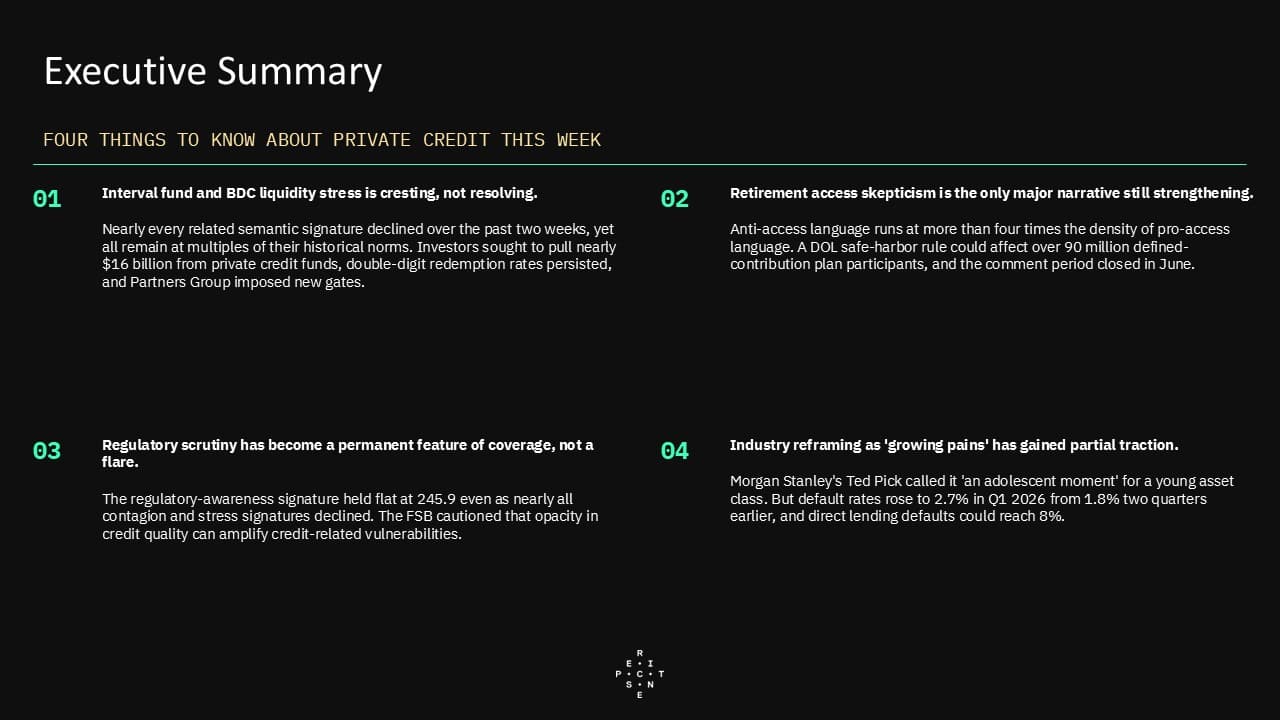
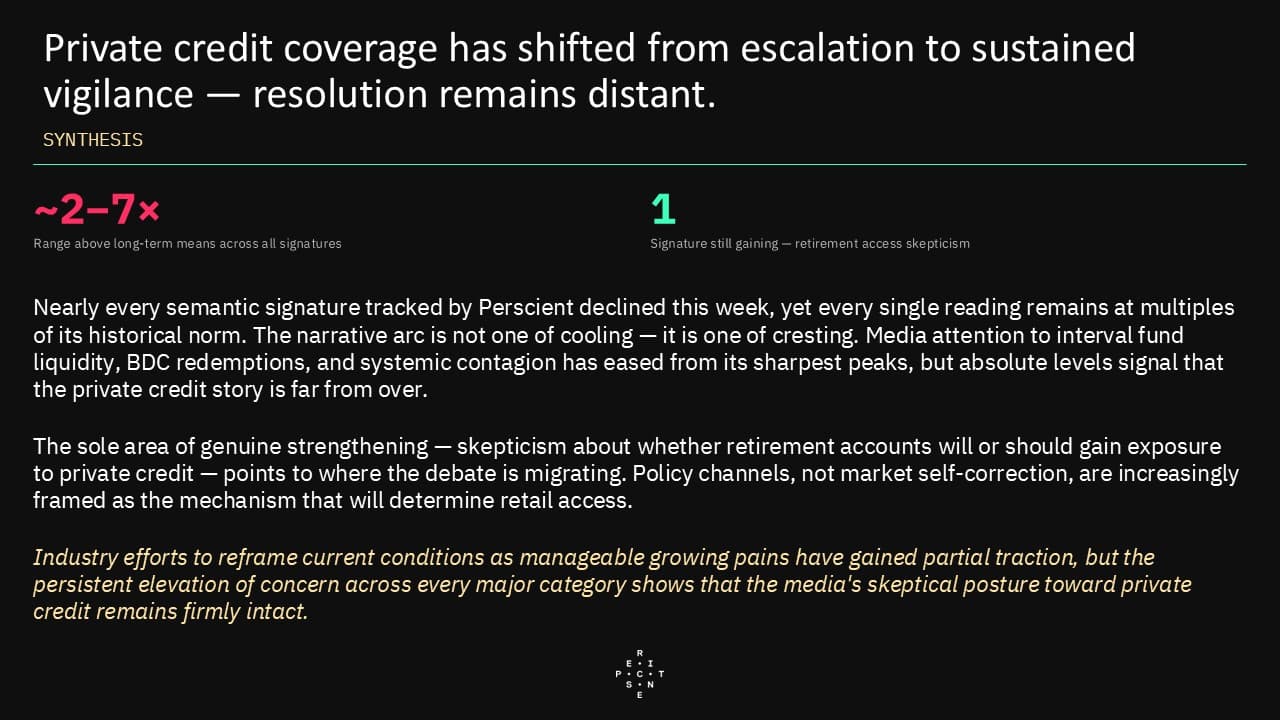
- Vehicle-specific concern narratives — covering interval funds, BDCs, and alternative manager concentration — dominate private credit media at extraordinarily elevated levels, anchored by first-quarter redemption data showing that only about half of requested withdrawals were fulfilled and that multiple funds hit their quarterly caps. Despite this intensity, these signatures have flattened rather than escalated, suggesting that media has settled into sustained vigilance over managed friction rather than alarm over imminent systemic failure.
- The retailization debate has tilted decisively toward skeptics, with anti-access narratives carrying far more weight than pro-access counterparts and advocacy for ETF-based private credit access virtually absent from media discourse. This imbalance stands in direct tension with the Department of Labor's active proposal to open retirement accounts to alternatives, and the redemption difficulties documented in vehicle-specific coverage provide skeptics with a steady supply of supporting evidence.
- Systemic interconnection concerns — spanning insurance balance sheets holding approximately 35% of U.S. insurer investments in private credit, bank warehouse lines, and the retail distribution channel — remain durably elevated. A persistent gap between senior officials' reassurances and countervailing signals from academic research, Federal Reserve and Treasury inquiries, and prominent investors like Warren Buffett sustains this narrative cluster even in the absence of a single catalyzing event.
- The most defining feature of the current two-week period is stasis across the entire narrative environment: no private credit media signature moved meaningfully in either direction, indicating that the discourse has reached an entrenched plateau of concern where neither fresh alarms nor official containment efforts are altering the tone. Allocators should recognize that this stability reflects not resolution but rather an uneasy equilibrium in which structural tensions — redemption friction, regulatory ambiguity, and systemic linkage questions — remain fully priced into media sentiment.
---
Interval Fund and BDC Redemption Pressures Anchor the Most Elevated Narratives in Private Credit Media
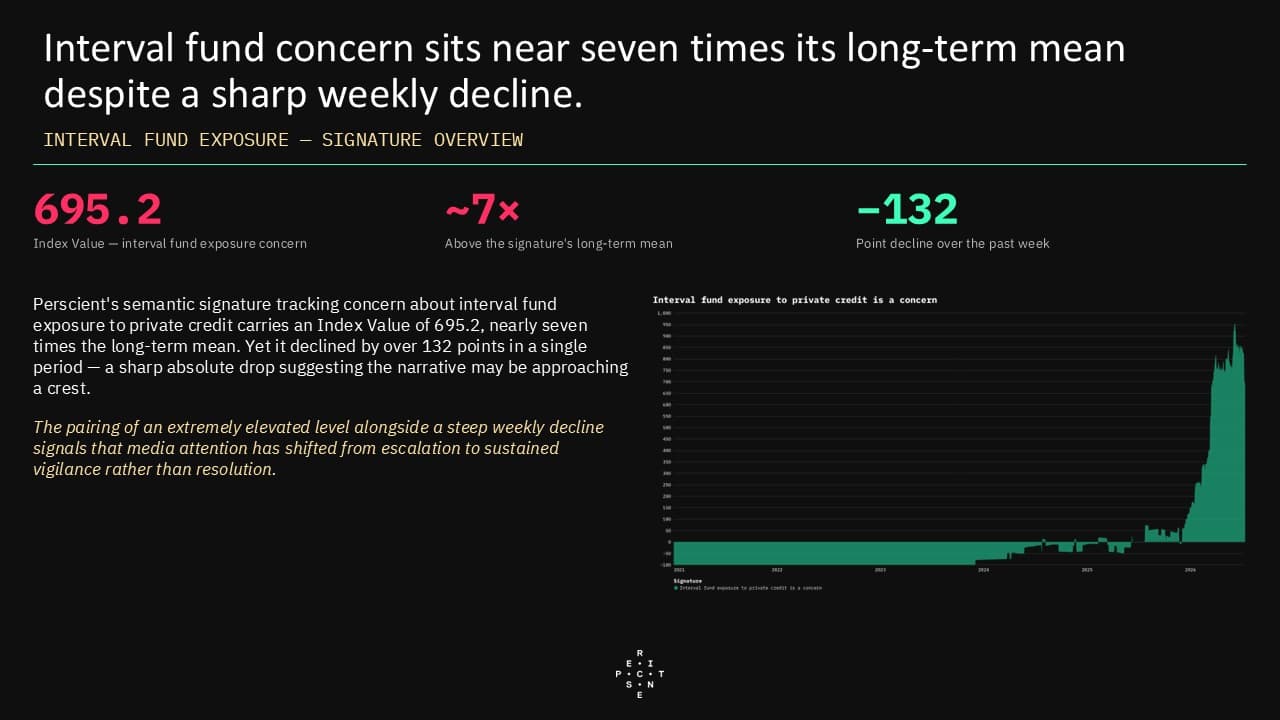
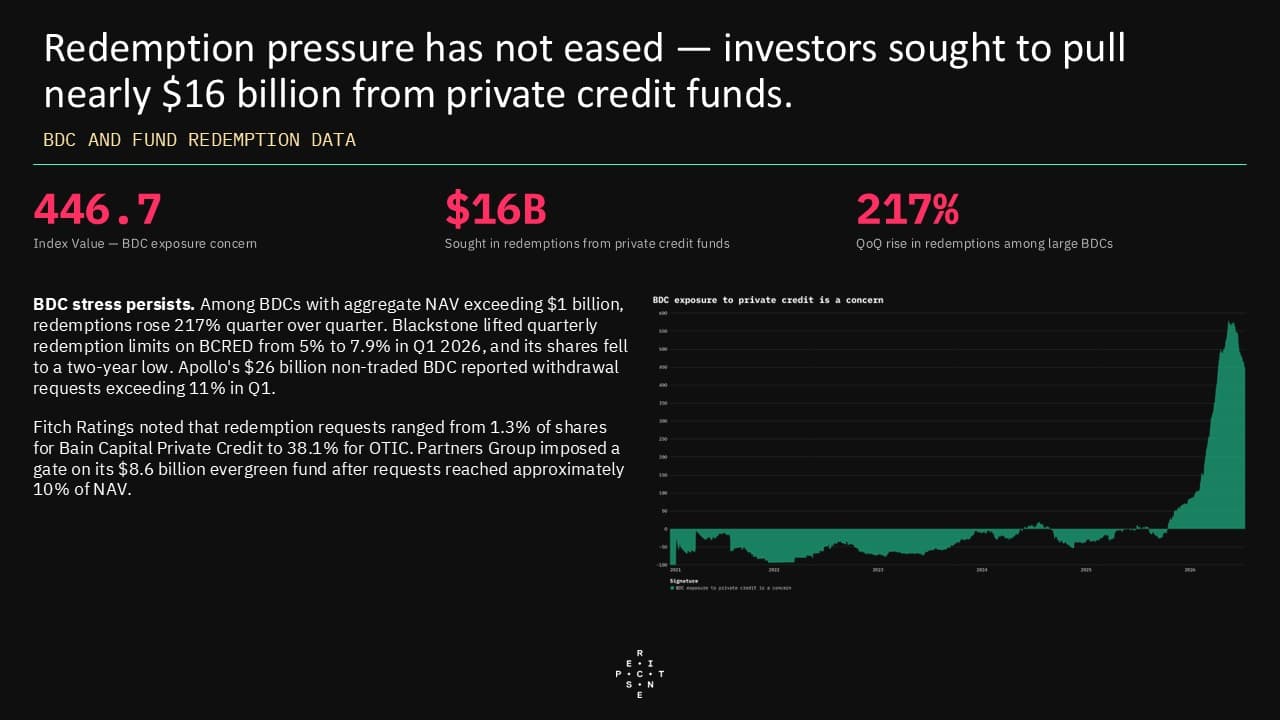
Perscient's semantic signature tracking the density of language expressing worry about interval funds' private credit holdings registers an Index Value of 1882.4, by far the strongest reading across all private credit signatures and nearly 19 times above its long-term mean. This value remained flat over the prior two weeks, indicating that media focus has stabilized at a very elevated level rather than continuing to climb. The closely related signatures tracking worry about BDC private credit risks and alternative managers' private credit concentration sit at 849.1 and 849.3 respectively, both well above average and both similarly steady. Together with the interval fund reading, they form a cluster of vehicle-specific concern that dominates the current narrative environment.
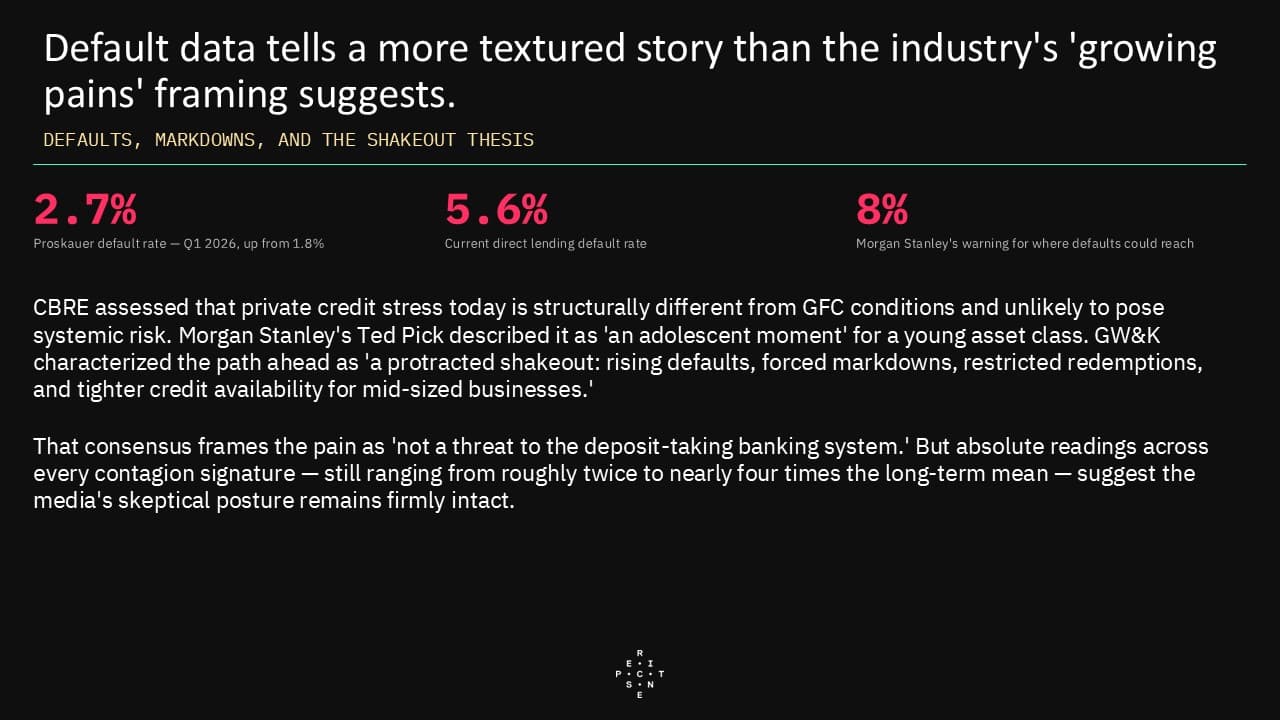
The practical basis for these elevated readings is visible in first-quarter redemption data. Private credit direct lending redemptions reached $19.5 billion in Q1 2026, but only 53% of that amount was returned to investors, leaving a substantial backlog of unfulfilled requests. Blue Owl faced particularly acute pressure: investors requested withdrawals of roughly 41% of shares in its $6.2 billion technology-focused fund and 22% in its $36 billion credit income fund, prompting the firm to cap redemptions at 5% of each fund's assets. Carlyle's flagship private credit interval fund received repurchase requests amounting to 15.7% of shares outstanding, more than triple its quarterly limit. Fitch noted that inflows to perpetually non-traded BDCs slowed by 40% from January to March, while funded redemptions rose to 5.3% of shares and negative net flows became widespread.
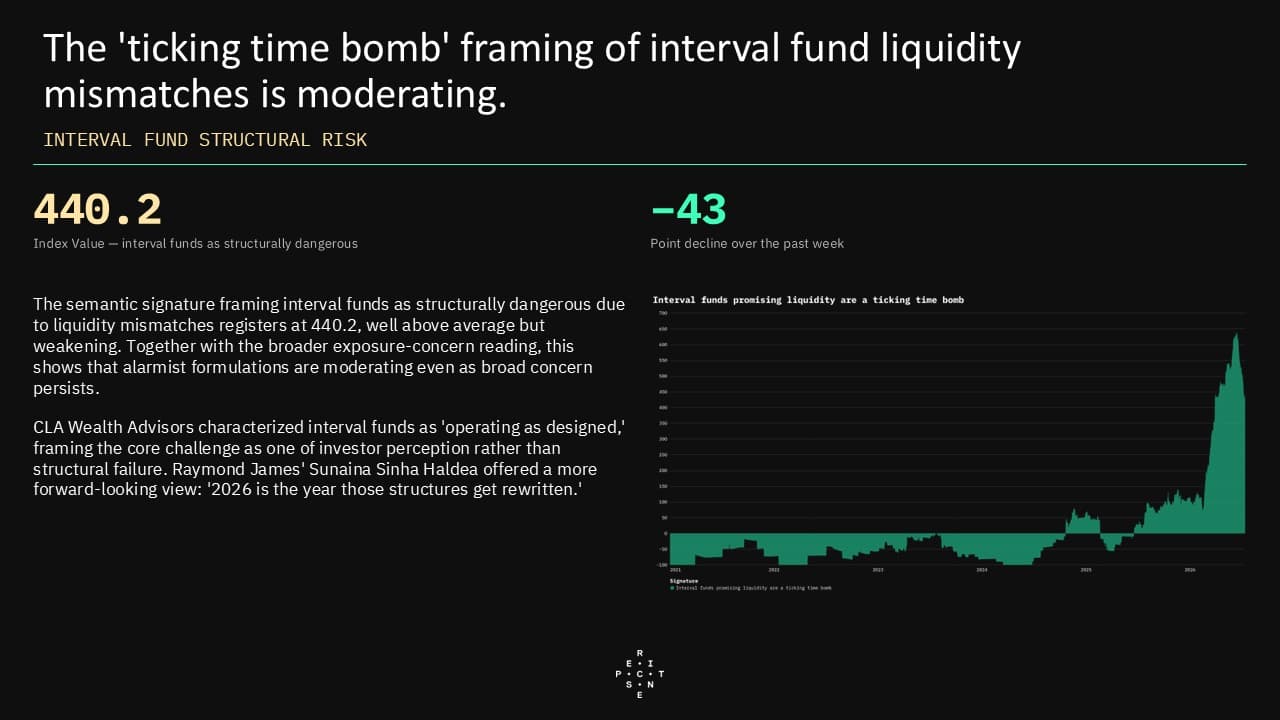
Despite these redemption pressures, new product launches continue. Morgan Stanley filed to debut a private credit interval fund anticipating quarterly redemptions of 5% of outstanding shares, a move that Alternative Credit Investor reported alongside similar launches from T. Rowe Price, Oak Hill Advisors, and JPMorgan Chase. Separately, Blackstone lifted its quarterly redemption cap on its flagship BCRED fund from the usual 5% to 7.9% to meet rising investor demand. The juxtaposition of fresh product issuance with ongoing redemption friction feeds directly into our semantic signature tracking language characterizing interval funds as dangerous due to liquidity mismatches, which stands at an Index Value of 462.8. Carlyle CEO Harvey Schwartz offered a candid reframing of the structural issue: "The industry did itself a bit of a disservice calling the vehicles semiliquid. We just should have called them 'sometimes not liquid at all.'"
Moody's revised its outlook on BDCs from stable to negative. HedgeCo Insights reported that the agency cited concerns over liquidity mismatches, elevated leverage, and accelerating redemption pressure; non-traded BDCs, representing approximately 60% of the market, were deemed particularly vulnerable. The flatness of all three vehicle-concern signatures over the two-week window suggests that the media has settled into sustained watchfulness, consistent with an environment where redemption pressures are being managed with visible friction rather than spiraling out of control.
The Retailization Debate Tilts Decisively Toward Skeptics Even as Policy Opens the Door to 401(k) Access
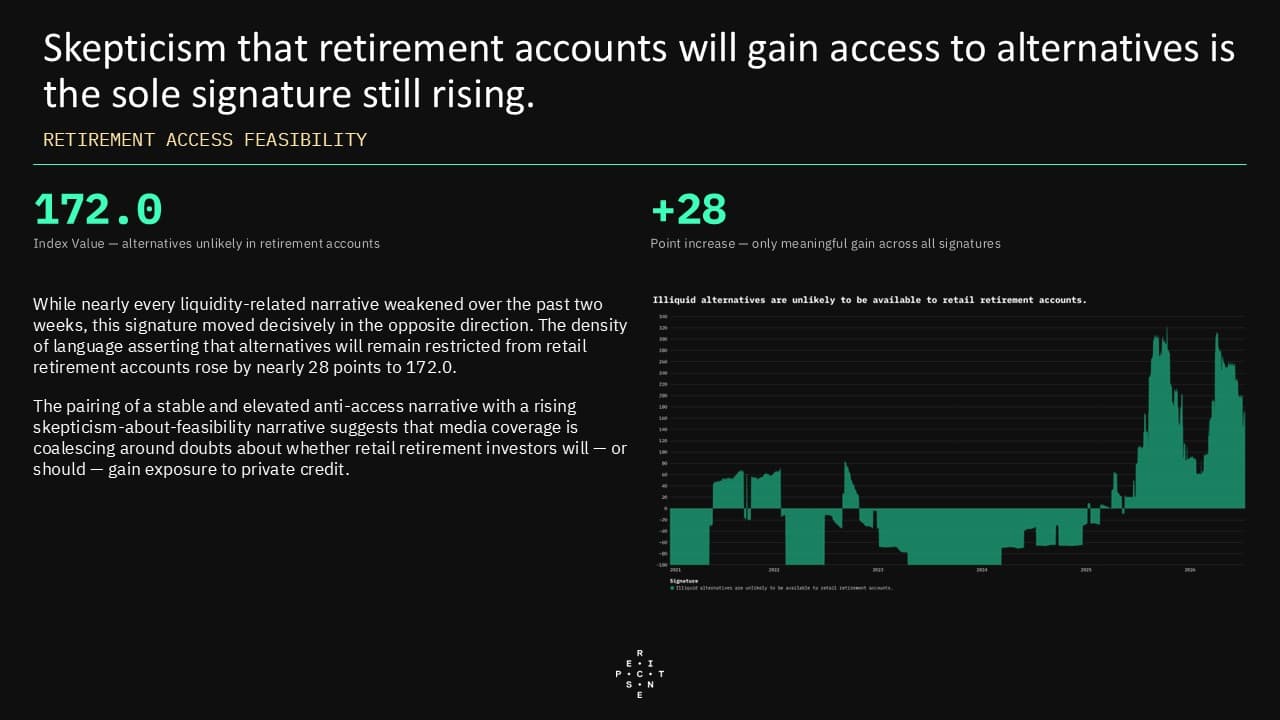
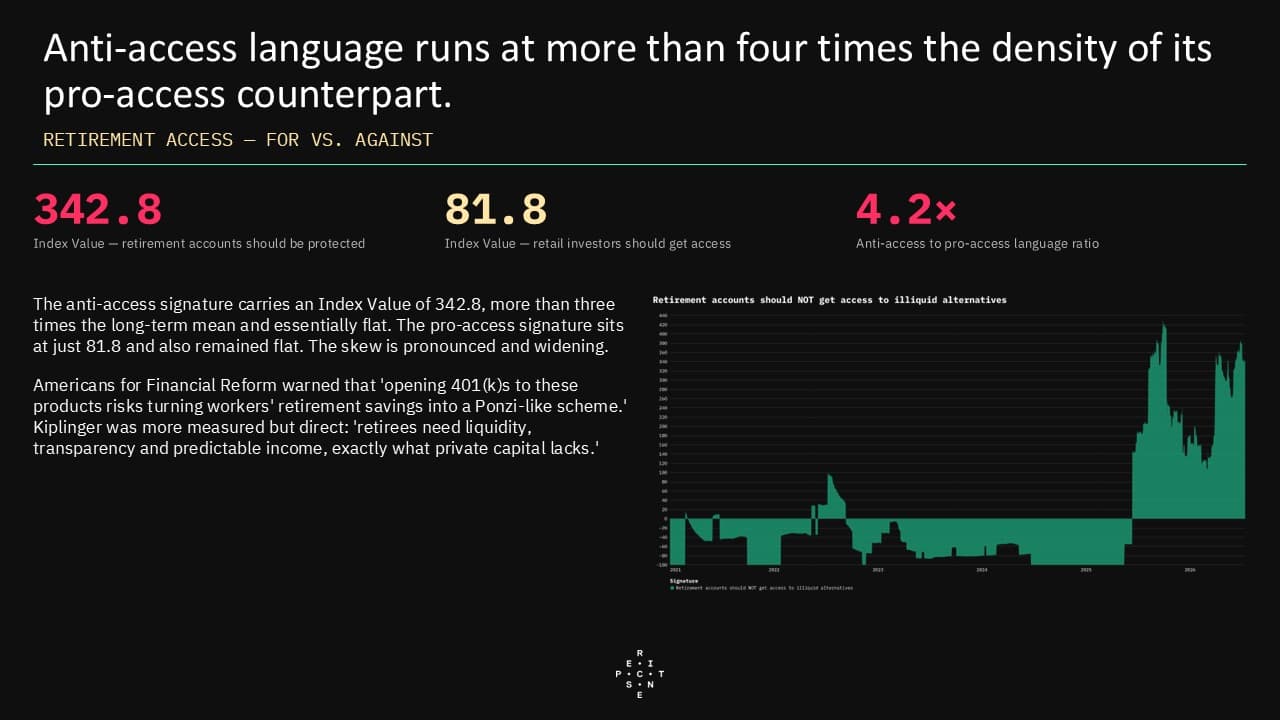
The redemption difficulties described above feed directly into a broader and increasingly lopsided debate about retail access to private credit. Perscient's semantic signature tracking the density of language arguing that retirement accounts should be protected from alternative investments stands at 790.8, the fourth-strongest reading across all signatures. Our companion signature tracking language arguing that ETFs should not be used as vehicles for illiquid alternatives like private credit sits at 622.8. Both held steady over the two-week period and both sit considerably above average. These anti-access narratives carry substantially more media weight than their pro-access counterparts, which trail at 343.3 and 396.0 respectively.
Most striking is the signature tracking language arguing that alternatives like private credit should be available through ETF vehicles, which sits at an Index Value of negative 100, the only reading in the entire dataset below its long-term mean. This near-complete absence of advocacy for ETF-based access is significant given that private credit ETFs already exist in the market, though they typically gain exposure indirectly and only as a portion of overall fund assets.
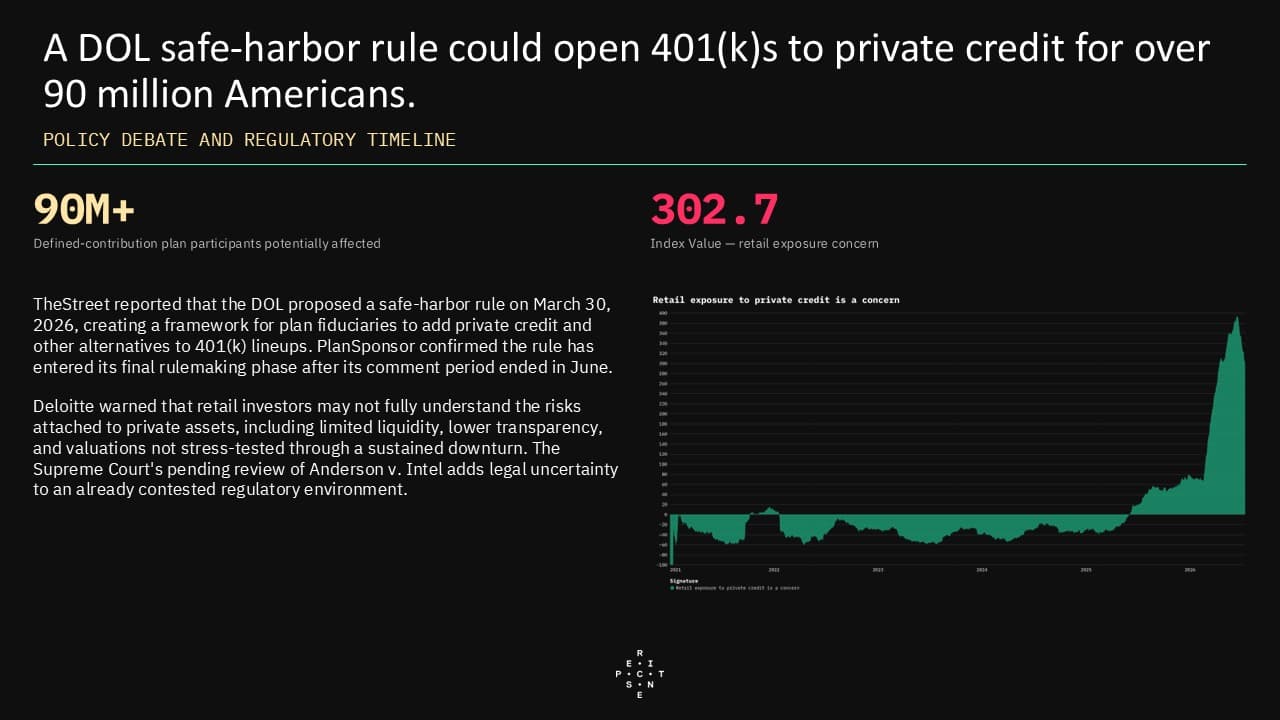
The tension between regulatory action and media skepticism is particularly visible. On March 30, the Department of Labor officially issued a proposal opening the door for alternative assets including private equity, credit, and cryptocurrency to be included in retirement accounts for more than 90 million Americans. CEPR documented that the White House had the proposal in hand since January 13 but delayed announcing it for more than two months, apparently concerned that turmoil in private credit markets might cast a shadow over the initiative.
The policy move has drawn sharp criticism. SEC Commissioner Crenshaw warned in remarks cited by Equitable Growth that "as calls for retail investor access to private markets accelerate, I am concerned that we are headed for a high-speed collision, with Main Street retail investors left without airbags." Senator Elizabeth Warren stated on social media that "Wall Street wants to dump its risky assets in your 401k." The SEC's 2026 examination priorities now explicitly reference private credit and private funds with investment lock-ups for extended periods, and Katten noted that litigation has already followed, including a case in which a plaintiff alleged that a publicly traded BDC's net asset value had been misrepresented.
One particularly pointed line of skepticism argues that retailization is less about democratizing access than about finding fresh capital. As one analysis framed it, pensions, endowments, and sovereign wealth funds have reached their allocation ceilings, making the $12.4 trillion in American defined-contribution plans "the only pool of capital large enough to absorb the overflow." Employers may face litigation risk if they allow private credit into 401(k)s, particularly given recent publicity about redemption difficulties. The asymmetry between anti-access and pro-access signatures suggests that media discourse has been substantially shaped by events of recent months, and allocators should monitor this gap as the DOL's 60-day comment period unfolds.
Systemic Linkage and Insurance Exposure Concerns Sustain Questions About Private Credit Under Stress
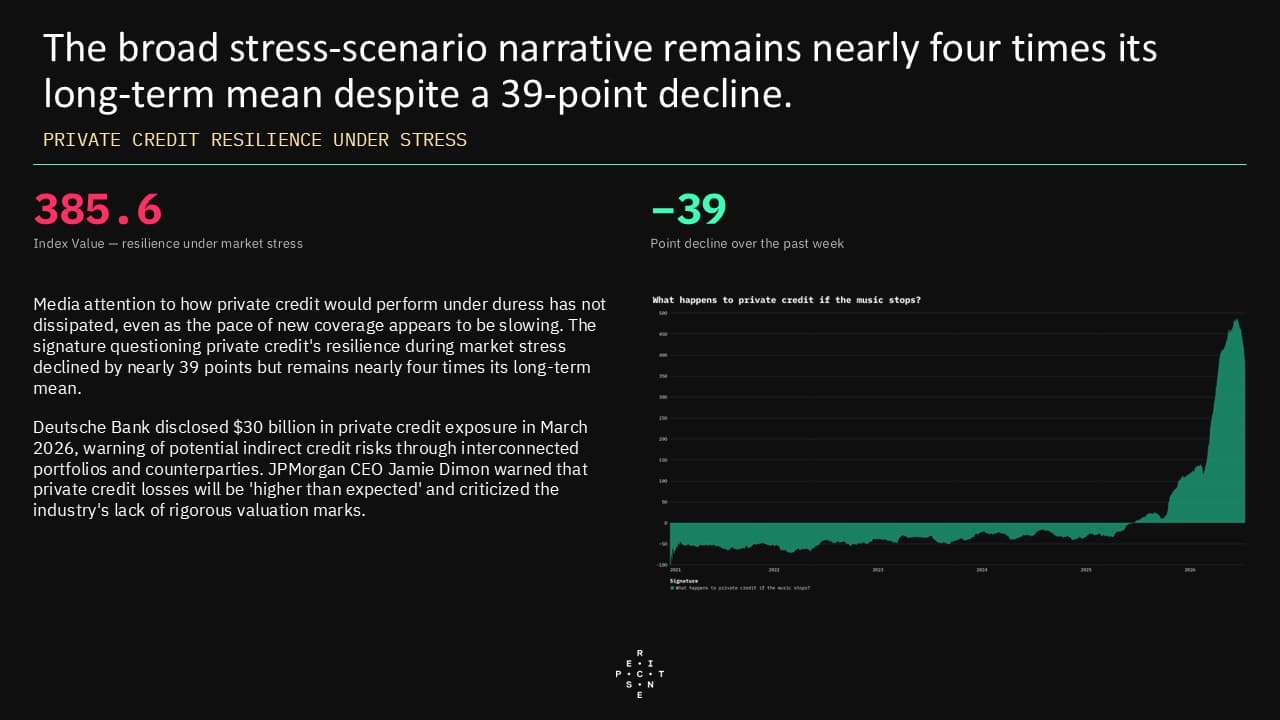
Retailization concerns intersect with broader questions about private credit's systemic connections. Perscient's semantic signature tracking the density of language questioning private credit's resilience during market stress registers at 657.2, the fifth-highest reading in the dataset, and was unchanged over the two-week period. At more than six times above its long-term mean, this indicates persistent apprehension about the asset class's durability under adverse conditions.
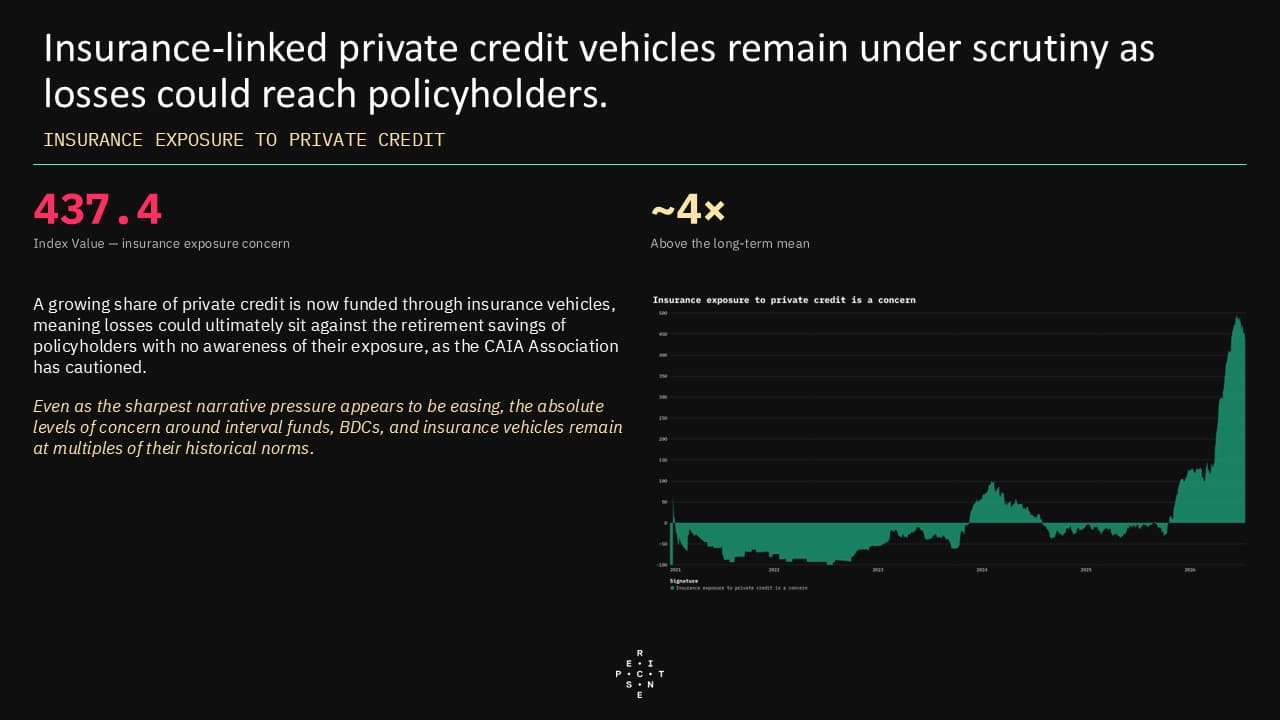
Insurance balance sheets represent one of the clearest channels of potential transmission. Our semantic signature tracking language expressing worry about insurance companies' exposure to private credit stands at an Index Value of 468.4. Private credit accounts for around 35% of total U.S. insurer investments and close to a quarter of UK insurer assets. Insurers affiliated with private equity firms hold an estimated $1 trillion in assets acquired through those relationships, a figure that has prompted the Federal Reserve and Treasury Department to seek detailed information from major banks about their exposure to private credit firms and insurers.
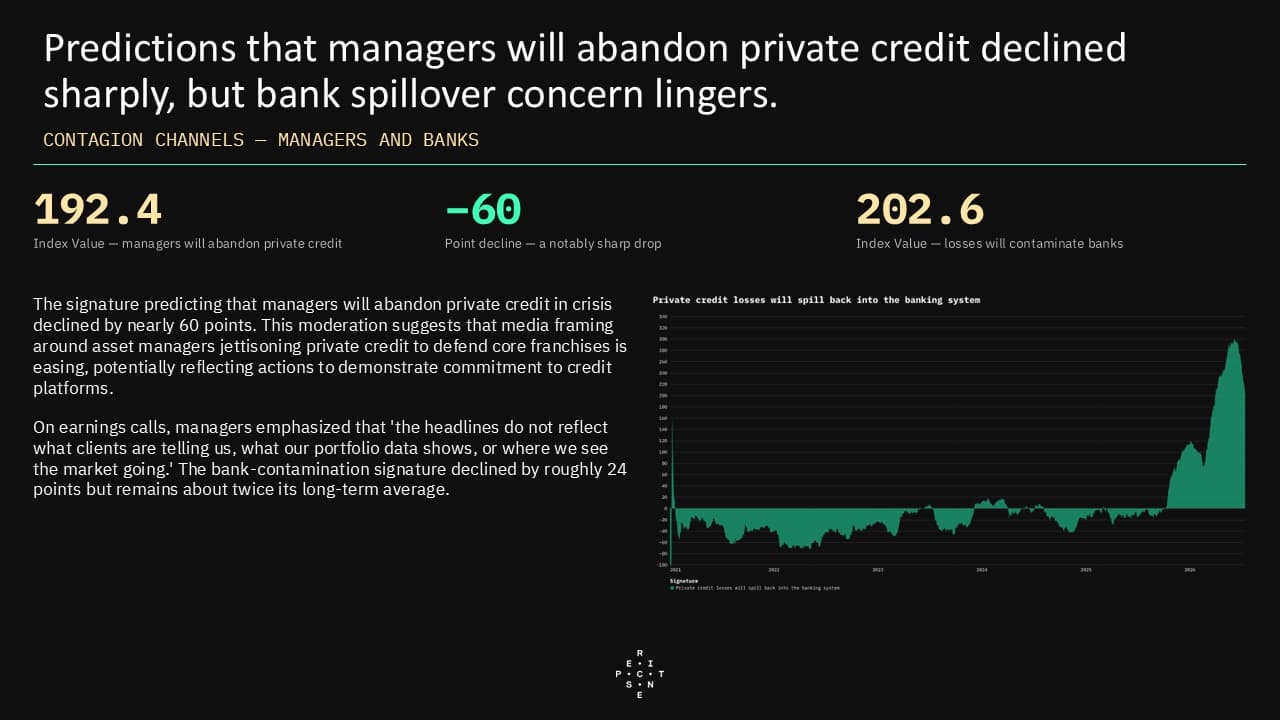
The banking system represents a second channel. Our semantic signature tracking language warning that private credit problems will contaminate banks sits at 353.5. As Forbes detailed, banks do not merely lend to private credit funds; they lend against private credit collateral, and when that collateral gets repriced, the whole chain tightens. Goldman Sachs' wide loss estimate range of 30 to 50% on certain exposures reflects the difficulty of modeling recovery timing and valuation in private credit. One observer characterized the situation as resembling "a slow-motion bank run," noting that loans banks are making to nonbank lenders accelerated more quickly than any other type of bank lending in recent years.
Senior officials have sought to contain alarm. JPMorgan Chase CEO Jamie Dimon wrote in his annual letter that private credit "probably does not present a systemic risk", though that assessment was considerably rosier than his observation last fall that there were likely more "cockroaches" lurking in the space. Federal Reserve Chair Jerome Powell said that stress in private credit does not appear to pose a systemic threat, and Treasury Secretary Bessent stated that Treasury sees no systemic risk. Yet Warren Buffett told Bloomberg that he is watching banking for signs of contagion, setting up a clear divergence in tone between policymakers and at least some prominent market participants.
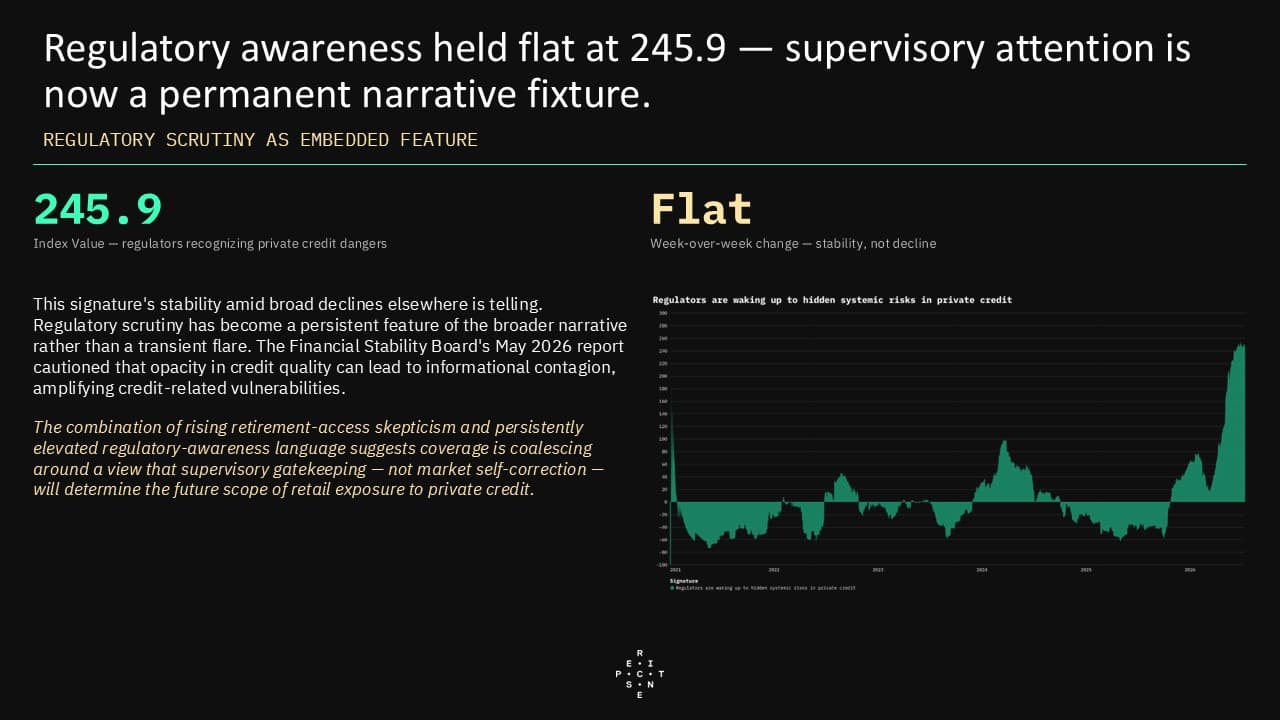
However, a recent Harvard Kennedy School paper published April 15 argues that growing interconnectedness between private credit funds and other financial institutions can amplify financial instability. Our semantic signature tracking language asserting that regulators are recognizing private credit dangers stands at 167.8, above average and unchanged over the period, consistent with increasing but measured regulatory attention. The National Association of Insurance Commissioners has adopted guidelines scheduled to take effect in 2026 that will allow state regulators to challenge credit ratings that appear inflated or conflicted, while both the SEC and Federal Reserve have signaled increased interest in the systemic implications of private credit growth.
No single event over the last two weeks has driven these systemic-concern signatures meaningfully higher, but neither has any reassurance brought them down. Private credit's connections through insurance balance sheets, bank warehouse lines, and the retail channel remain a durable feature of media coverage, and the narrative appears entrenched even as the highest-profile voices in finance seek to contain alarm.
Archived Pulse
April 07, 2026
- Interval Fund and BDC Liquidity Stress Dominates Private Credit Media Coverage
- The Retirement and ETF Access Debate Tilts Decisively Against Democratization in Media Framing
- Insurance Exposure and Systemic Contagion Narratives Sustain Broad-Based Institutional Anxiety
March 24, 2026
- Interval Funds and BDCs at the Epicenter of the Private Credit Liquidity Stress Test
- The Systemic Risk and Banking Contagion Debate Gains Momentum
- Retirement Access Narrative Tilts Protective as ETF Democratization Cools
March 10, 2026
- Interval Fund and BDC Concerns Reach Extraordinary Levels as Redemption Pressures Mount Across Semiliquid Vehicles
- The Paradox of Private Credit Democratization: Retirement Account Access Advances While Retail Risk Concerns Surge
- Stress Resilience Questions and Banking Contagion Narratives Intensify Even as Bubble Language Moderates
February 24, 2026
- Interval Fund, BDC, and Alternative Manager Exposure Concerns Reach Elevated Levels Amid Blue Owl Fallout
- The 401(k) Access Push Cools Slightly as Retail Investor Exposure Concerns Climb
- Secondary Market Liquidity Fears Rise as Valuation Skepticism Holds and Credit Quality Narratives Show Mixed Signals
February 10, 2026
- BDC Concerns Intensify Amid Software Sector Exposure and Late-Cycle Stress
- Valuation Opacity and Covenant Erosion Draw Regulatory Attention and Market Scrutiny
- Retirement Account Access Debate Intensifies as Interval Fund Concerns Rise
January 27, 2026
- Interval Funds and Semi-Liquid Structures Draw Scrutiny as Redemption Pressures Mount
- Valuation Concerns and Fraud Allegations Amplify ‘Opaque’ Narrative
- Retail Access to Private Credit Through Retirement Accounts Advances Despite Debate Over Investor Protections
January 14, 2026
- Interval Funds and Alternative Asset Manager Concentration Emerge as Central Risk Narratives
- Double-Pledged Collateral Concerns Intensify Again
- Valuation Opacity and Late-Cycle Credit Stress Dominate 2026 Outlook Narratives
December 31, 2025
- Tricolor Details Emerge, Reinforce Private Credit Fraud Concerns
- Alternative Asset Manager and Insurance Exposure Concerns Accelerate
- Regulatory Attention Sharpens as Systemic Risk Narratives Gain Traction
December 16, 2025
- Regulatory Momentum on Retirement Access Slows Despite Policy Tailwinds
- Interval Fund Narratives Strengthen as Alts Managers Expand Retail Offerings
- Banking System Interconnection Concerns Rise Alongside Regulatory Scrutiny
December 09, 2025
- Insurance-Private Credit Nexus Emerges as Focal Point for Systemic Concern
- Market Stress Resilience Questions Reach All-Time High Amid Default Warnings
- BDC Exposure Concerns Rise as Retail Access Narratives Moderate
November 24, 2025
- Private Credit Faces Collateral Integrity Questions as Stress Narratives Intensify
DISCLOSURES
This commentary is being provided to you as general information only and should not be taken as investment advice. The opinions expressed in these materials represent the personal views of the author(s). It is not investment research or a research recommendation, as it does not constitute substantive research or analysis. Any action that you take as a result of information contained in this document is ultimately your responsibility. Epsilon Theory will not accept liability for any loss or damage, including without limitation to any loss of profit, which may arise directly or indirectly from use of or reliance on such information. Consult your investment advisor before making any investment decisions. It must be noted, that no one can accurately predict the future of the market with certainty or guarantee future investment performance. Past performance is not a guarantee of future results.
Statements in this communication are forward-looking statements. The forward-looking statements and other views expressed herein are as of the date of this publication. Actual future results or occurrences may differ significantly from those anticipated in any forward-looking statements, and there is no guarantee that any predictions will come to pass. The views expressed herein are subject to change at any time, due to numerous market and other factors. Epsilon Theory disclaims any obligation to update publicly or revise any forward-looking statements or views expressed herein. This information is neither an offer to sell nor a solicitation of any offer to buy any securities. This commentary has been prepared without regard to the individual financial circumstances and objectives of persons who receive it. Epsilon Theory recommends that investors independently evaluate particular investments and strategies, and encourages investors to seek the advice of a financial advisor. The appropriateness of a particular investment or strategy will depend on an investor's individual circumstances and objectives.