Private Credit PulseBiweeklyNov 3, 2026
Private Credit Pulse
Next release: November 17, 2026


Next release: November 17, 2026
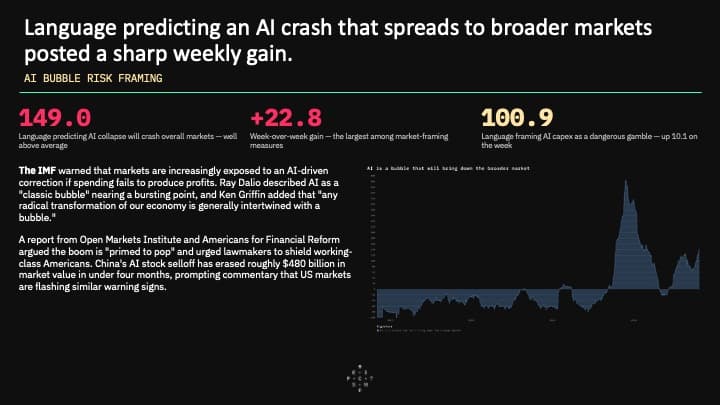
Coverage has relocated the bear case from technology to finance. Perscient's semantic signature tracking the density of language predicting that an AI investment collapse will crash overall markets posted the largest gain among market-framing signatures, carried by the IMF's stability warning, Dalio's "classic bubble" language, and the circular-financing critique now reaching Capitol Hill. Yet the signature tracking claims that AI hype is giving way to disappointment stayed flat and negative, which indicates that reporters are questioning who earns a return rather than whether the technology works. Conviction and alarm are growing simultaneously, not sequentially. The signature tracking language predicting a long-term AI investment supercycle recorded the single largest weekly gain in the entire set, moving out of negative territory at the same moment bubble language climbed. The press is staging a genuine two-sided argument heading into the Alphabet, Amazon and Apple prints, where the sell-side test has moved from growth to cash conversion. The bottleneck vocabulary has migrated from silicon to permission, power and memory. Language tracking GPU scarcity as a growth constraint sat below its long-term mean and has effectively left the conversation, while claims that opposition to large AI investments is increasing produced the highest reading in the entire set, powered by Oregon's statewide pause, Charlotte's extended moratorium and a flood of California local measures. Memory-shortage language cooled sharply on the week even though IDC and Michael Dell both describe worsening DRAM and HBM4 supply, suggesting that press attention is lagging the underlying constraint. Siting fights are still being covered as local disputes rather than a competitiveness emergency. The signature tracking arguments that national energy buildout will determine AI leadership rests near its long-term mean, which leaves a gap between the permitting friction documented in Section 2 and the geopolitical framing one might expect. Should interconnection queues and moratoriums persist, that gap is the most likely place for a new narrative to form. The leaderboard story has narrowed to one name while buyers are portrayed as disciplined rather than disillusioned.Anthropic's October 26 S-1 pushed the signature tracking claims of Claude's competitive lead to the dominant position, with OpenAI and Google framings both flat and negative; the filing's $80.7 billion half-year loss headline simultaneously feeds the risky-bet language described in Section 1. Meanwhile, the signature tracking corporate doubt about large AI spending strengthened even as claims of outright project failure weakened, and predictions about job destruction or creation remain deep in negative territory, leaving the week's coverage almost wholly financial and infrastructural.
Coverage of the buildout has become a zoning-and-grid story. Language claiming that opposition to large AI investments is increasing is now the densest signature in the set, and it is compounding with language asserting that construction delays are slowing AI growth. Memphis, Aurora, Leon County and Raleigh moratoriums, plus FERC's show cause orders to all six regional grid operators, gave reporters concrete local and federal hooks. Media is framing power as a permitting and ratepayer fight rather than a geopolitical race, since the signature treating AI leadership as a contest of national energy buildout sits flat near its mean. Bubble language has hardened around financing structure and index concentration rather than around technological disappointment. Signatures tracking predictions of an AI-driven market crash and characterizations of infrastructure spending as a dangerous gamble both climbed, while language claiming that hype is giving way to disappointment stays well below its mean. The IMF's circular-deal tally, Cembalest's concentration statistics and the CoreWeave "subprime tranche" line carried the week. The specific 1990s telecom-overbuild analogy fell further below its mean, which suggests that commentators are prosecuting a credit-and-plumbing case instead of an overcapacity one. Enterprise buyers are demanding payback evidence without renouncing the technology. Language asserting that businesses increasingly doubt large AI spending posted the single largest weekly increase in the file, yet signatures claiming failed corporate initiatives or absent efficiency gains remain near or below their means, and the signature tracking AI's translation into company profits firmed. Gartner's finding that only 13% of CIOs report meaningful value, alongside Citi and Bank of America quantifying returns, shows coverage centered on governance and accountability rather than abandonment. The market payoff question and the boardroom payoff question are now the same story told to two audiences. Investors interrogating returns on capital expenditure and CIOs interrogating total cost of ownership draw on the identical evidentiary frame, which explains why systemic-contagion language and buyer-doubt language rose together while the supercycle rebuttal also strengthened. Fear-of-missing-out messaging is not landing; the signature claiming that companies must adopt AI or fail competitively stayed flat below its mean. Media's vendor leaderboard has collapsed to a single name while input constraints define the broader frame. Language asserting Anthropic's leadership stands far ahead of the OpenAI and Google equivalents, boosted by IPO anticipation and quarterly revenue reporting, while the xAI leadership signature recorded the largest weekly decline despite an active shipping cadence. Combined with rising language on training-data scarcity and the land, power and memory constraints of Section 1, the week's dominant frame moved from what AI can do toward what AI can obtain.