
Private Credit Pulse
Private Credit Pulse June 02, 2026




Executive Summary
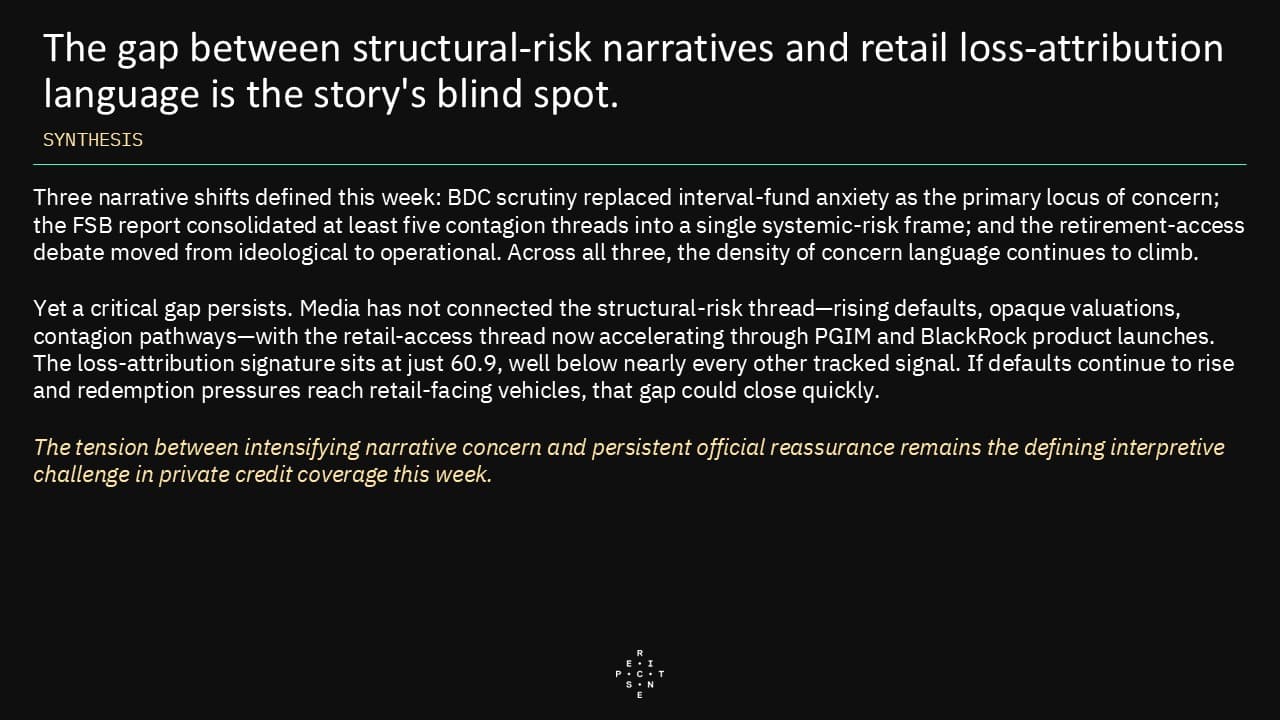
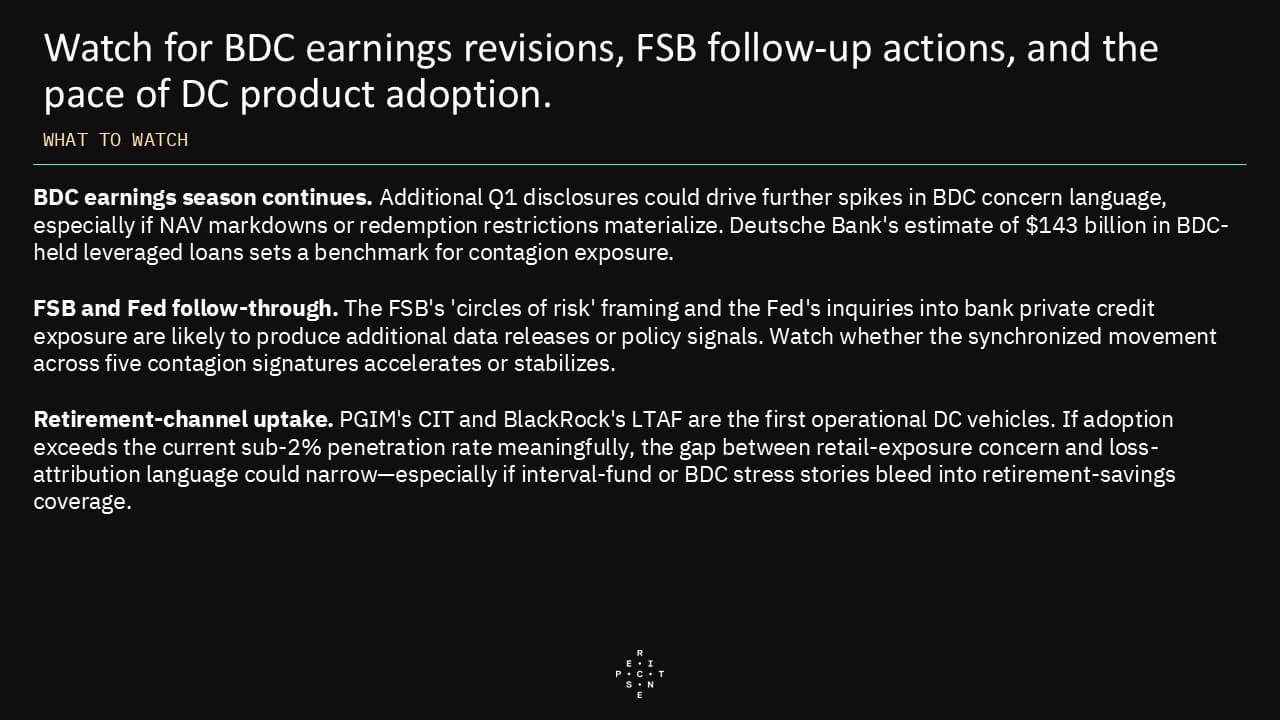
- Interval funds have overtaken BDCs as the primary locus of media anxiety about semi-liquid private credit structures. Language expressing worry about interval fund holdings recorded the highest intensity of any tracked signature and posted the largest single-week increase in the entire dataset, while BDC concern—though persistently elevated—has plateaued. The combination signals that media framing is broadening from stories about individual vehicles toward systemic questions about the entire category of semi-liquid private credit, fueled by concrete catalysts such as Cliffwater's redemption requests at double its quarterly cap and the first quarter in which non-traded fund outflows exceeded inflows.
- Coverage of insurance and alternative manager interconnection has evolved from generalized unease toward specific predictions about how managers will behave under stress. The fastest-accelerating narrative in this cluster is language predicting that alternative managers will sacrifice private credit vehicles to protect their flagship businesses—a framing that gained more momentum than the broader worry about manager concentration itself. The Financial Stability Board's May report quantifying bank credit-line exposure and the NAIC's forthcoming disclosure requirements have given journalists concrete institutional anchors for this storyline, while insurance-sector underperformance has sharpened the rhetorical edge.
- The retail access debate has tilted decisively toward caution, with protective language now running at nearly double the intensity of pro-access language and the gap widening further over the past week. Redemption episodes in interval funds and BDCs have furnished critics with case studies that directly undercut the "democratization" framing favored by both the industry and the current administration's policy agenda. Meanwhile, enthusiasm for ETF-based private credit distribution has dissipated almost entirely, with relevant semantic signatures falling to or below long-term averages.
- A reinforcing loop across all three narrative clusters has emerged in media coverage: rising defaults, redemption stress, and regulatory scrutiny are being treated not as isolated incidents but as interlocking evidence of structural vulnerability. Fitch's record 6.0% private credit default rate, the FSB's interconnection warnings, and congressional attention to redemption restrictions are woven together in coverage that frames the entire private credit ecosystem—from origination through insurance balance sheets to retail distribution—as facing a synchronized test of resilience.