


Markets Pulse
WeeklyOctober 6, 2026

AI Pulse September 29, 2026

9.29AIPulse1.jpg
9.29AIPulse2.jpg
9.29AIPulse3.jpg
9.29AIPulse4.jpg
9.29AIPulse5.jpg
9.29AIPulse6.jpg
9.29AIPulse7.jpg
9.29AIPulse8.jpg
9.29AIPulse9.jpg
9.29AIPulse10.jpg
9.29AIPulse11.jpg
9.29AIPulse12.jpg
9.29AIPulse13.jpg
9.29AIPulse14.jpg
9.29AIPulse15.jpg
9.29AIPulse16.jpg
9.29AIPulse17.jpg
8.11AIPulse18.jpg

EXECUTIVE SUMMARY

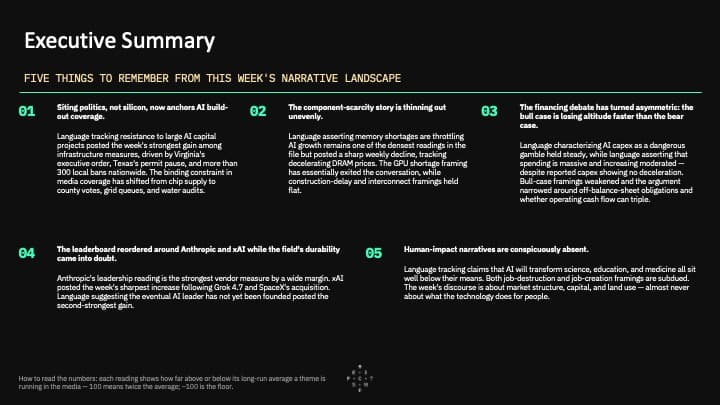
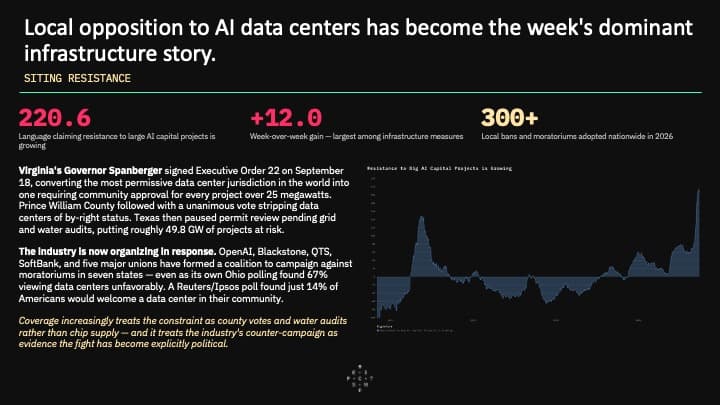
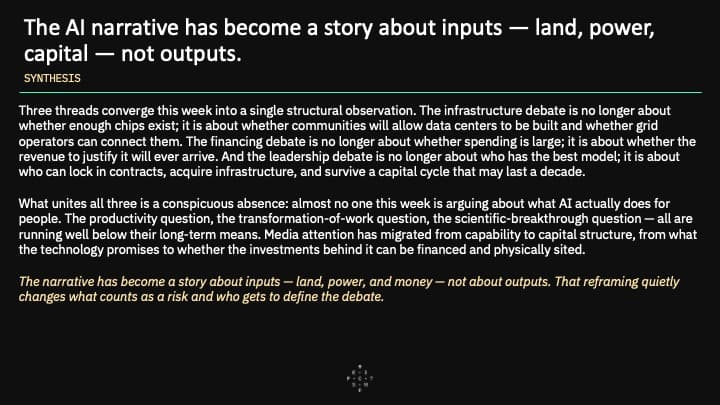
  • Siting politics, not silicon, now anchors build-out coverage. Perscient's semantic signature tracking the density of language claiming opposition to large AI investments posted the largest gain among infrastructure-constraint measures, driven by Virginia's executive order, Texas's permit pause, New York's hyperscale moratorium, and a count of more than 300 local bans nationwide. Coverage increasingly frames the binding constraint as county votes, grid queues, and water audits rather than chip supply — and it treats the newly formed industry coalition against moratoriums as evidence that the fight has become explicitly political.
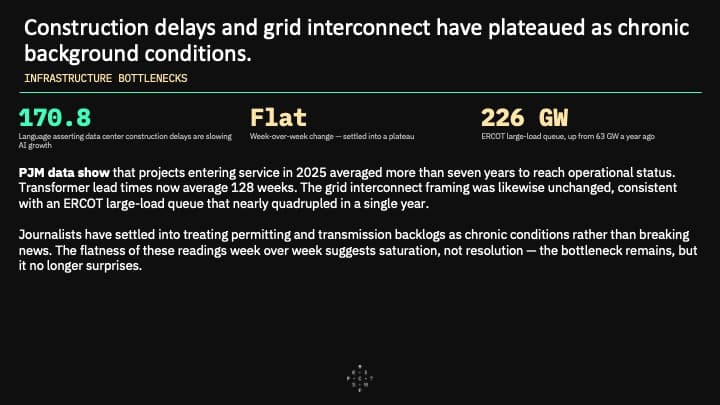
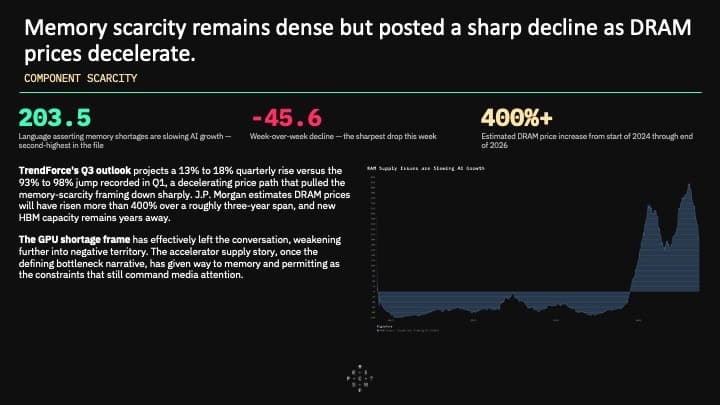
  • The component-scarcity story is thinning out unevenly. Language asserting that memory shortages are throttling AI growth remains one of the densest readings in the file but recorded the sharpest weekly decline we measured, tracking a decelerating DRAM price path, while the accelerator-shortage framing has essentially exited the conversation. Meanwhile, framings around construction delays and grid interconnection held flat, suggesting that journalists have settled into treating permitting and transmission as chronic conditions rather than breaking news.
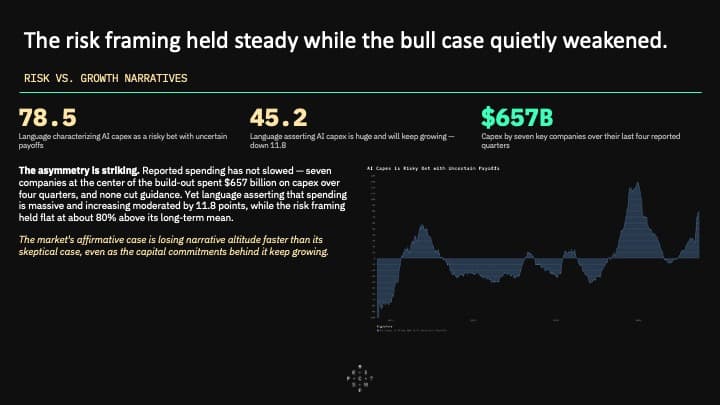
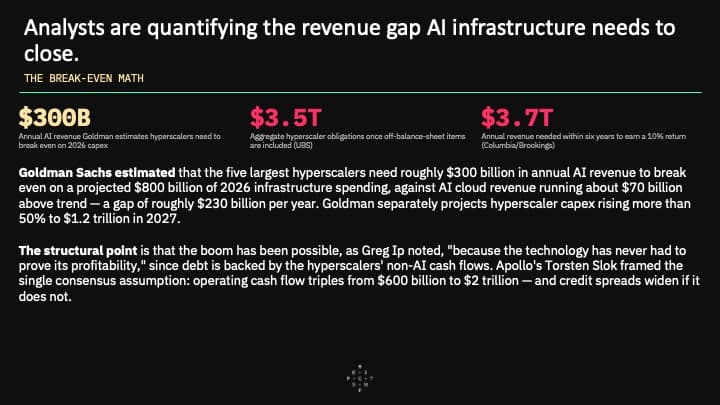
  • The financing debate has turned one-sided in an unusual way: the affirmative case is losing altitude faster than the skeptical case. Language characterizing AI infrastructure spending as a dangerous gamble held its level, while language asserting that such spending is massive and increasing moderated — despite reported capex showing no deceleration whatsoever. Bull-case framings around a new bull market and durable AI trade weakened, and the collapse-contagion framing eased as well. What remains is a narrower, more technical argument about off-balance-sheet obligations, non-cancelable commitments, and whether operating cash flow can triple.
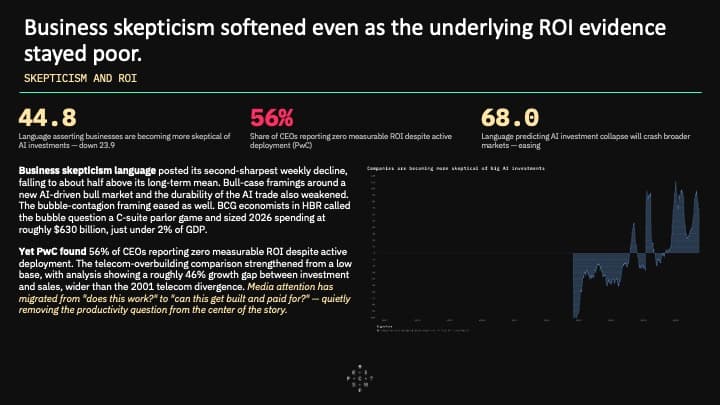
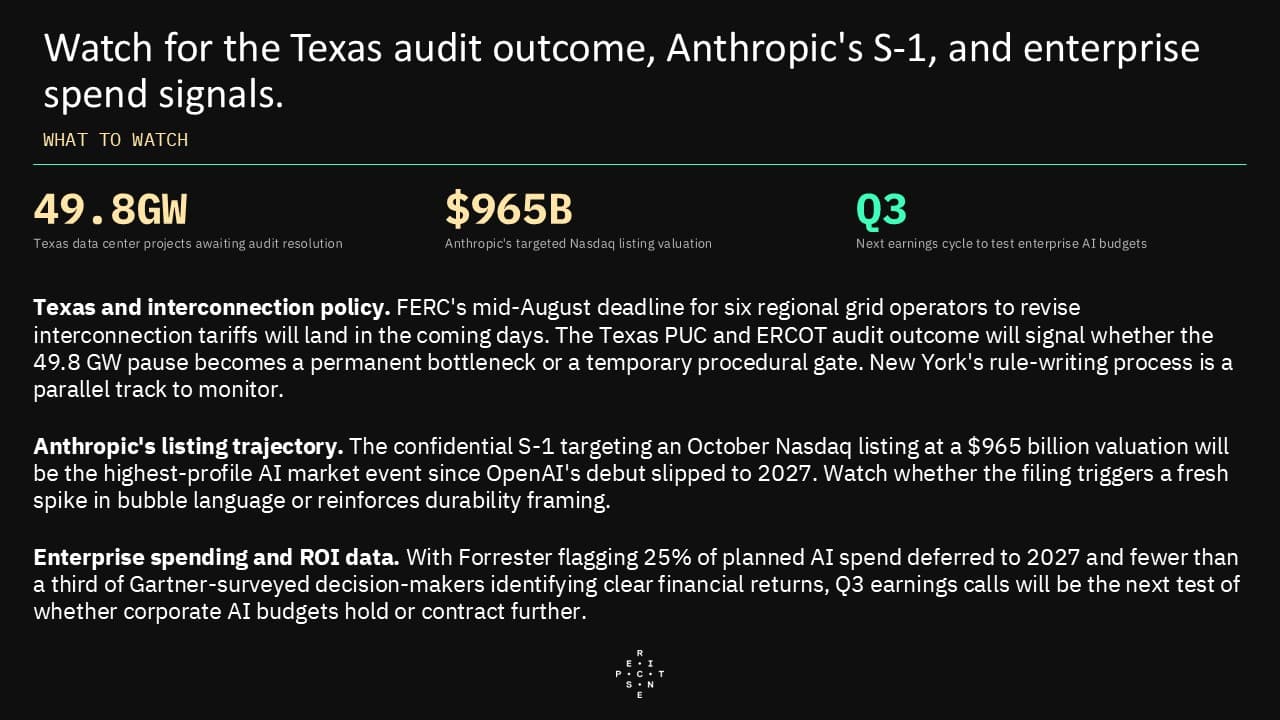
  • Business skepticism narratives softened even as the underlying ROI evidence stayed poor, with one survey finding a majority of CEOs reporting no measurable return. Taken together with Section 1, the implication is that media attention has migrated from "does this work?" to "can this get built and paid for?" — a reframing that quietly removes the productivity question from the center of the story.
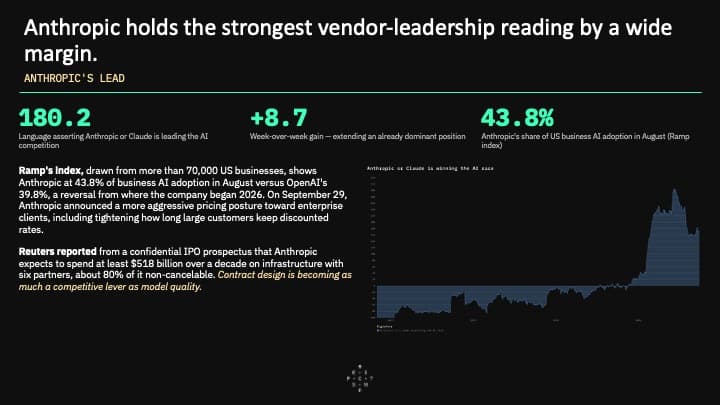
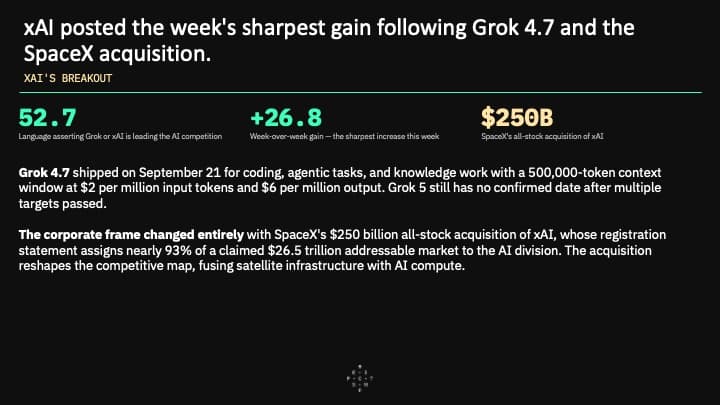
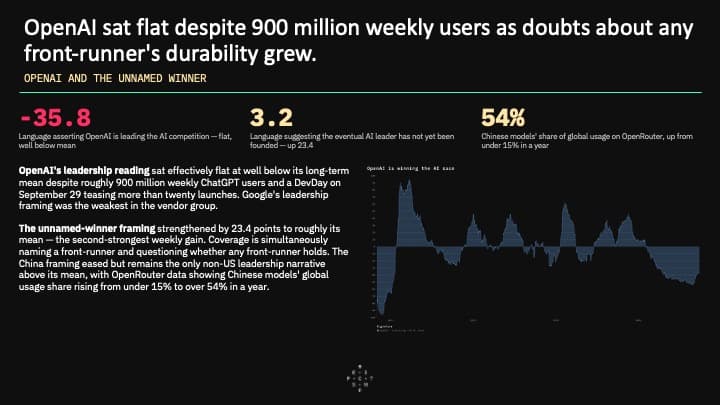
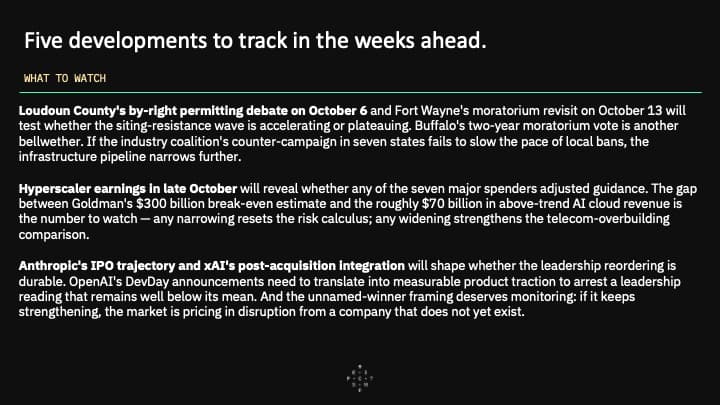
  • The leaderboard reordered around Anthropic and xAI while the field's durability came into doubt. Anthropic's leadership signature is the strongest vendor reading by a wide margin, xAI's recorded the largest weekly increase in the entire file following Grok 4.7 and the SpaceX acquisition, and OpenAI's sat flat despite DevDay. Notably, the framing claiming that the eventual AI leader has not yet been founded posted the second-largest weekly gain — coverage is naming a front-runner and simultaneously doubting that any front-runner holds.
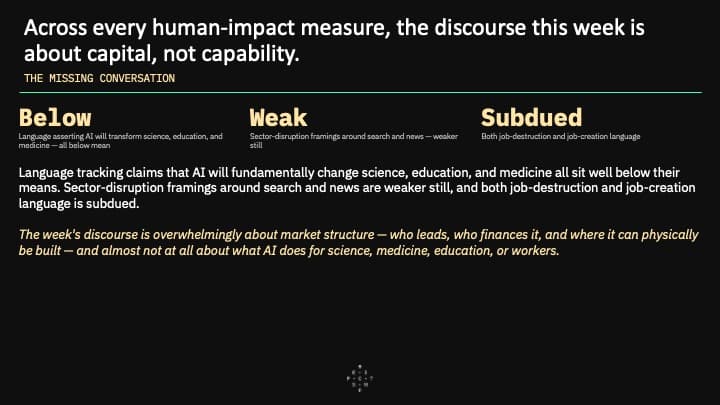
  • Human-impact narratives are conspicuously absent. Signatures tracking claims that AI will transform science, education, and medicine all sit well below their means, sector-disruption framings are weaker still, and both job-destruction and job-creation language is subdued. Across all three sections, the week's discourse is about market structure, capital, and land use — almost never about what the technology actually does for people.

Recent Pulses

Markets PulseWeeklyOct 6, 2026

Markets Pulse September 29, 2026

Financial media have converged on an oil-driven inflation story and an almost unanimous tightening prescription. Our semantic signature tracking the density of language suggesting that investors expect inflation to accelerate strengthened sharply this week, and hawkish policy-prescription language intensified while dovish counterparts stayed flat and depressed. Just as telling is what is absent: language expressing uncertainty about future central bank decisions eased well below its long-term mean, meaning commentators are not arguing about direction so much as amplifying a settled one. The single pocket of genuine confusion sits in labor policy, where immigration and employment-rule uncertainty language rose steeply, leaving payrolls as the one variable the consensus cannot confidently pre-write. Multi-decade-high yields are being reported without the usual crisis vocabulary. Signatures tracking flight-to-safety language across Treasurys, the yen, the Swiss franc, gold and money funds all sit far below their long-run norms during an active war, and geopolitical policy uncertainty language registered as merely ordinary. Gold in particular has been reframed: the signature presenting it as an attractive alternative to Treasurys posted the largest single-week decline in our dataset, and commentary now attributes precious-metals moves to real yields and dollar strength rather than to geopolitical anxiety. The fiscal-debasement explanation for high yields is in retreat even while the yields themselves make new highs. Signatures linking adverse Treasury outcomes to runaway spending, deficits, unfunded tax cuts and foreign buyer behavior all cooled from elevated bases, and dollar-debasement framing cooled alongside them. These readings remain above long-run norms because the underlying fiscal picture has not improved; what has changed is the marginal explanation media reach for, which has rotated from reserve-currency risk toward energy and the Federal Reserve. Tariff politics have flipped from justification to liability, and the displacement of tariffs as the assumed price culprit is directly connected to the energy story. Language characterizing Americans as broadly opposed to tariffs surged to one of the highest absolute readings in the entire set, expectations language reversed toward tariff reduction, and every affirmative justification framing — fair share, domestic protection, reshoring, reciprocal liberalization — weakened at once. Advice language urging investors to fade tariff fears strengthened considerably. Because oil now owns the inflation narrative, tariffs are no longer treated as the inflation driver, and trade policy uncertainty language fell despite an unsettled legal architecture and continued sectoral escalation in pharmaceuticals and Canadian goods. Two narrative streams are pulling in opposite directions ahead of the midterms. Section 3's relief orientation — reinforced K-shaped economy language, heavy relief-policy framing, an elevated helicopter-money signature, and weakening attention to deficit reduction and debt paydown — feeds directly into the Treasury-supply pressure underlying Section 2's multi-decade-high long rates. Equity commentary reflects the same fracture, where language describing a market splitting between a handful of winners and everything else strengthened while the case for US large-cap growth as the only option stayed pinned at its floor, and cross-border rotation stories faded rather than accelerated.

Markets PulseWeeklyOct 6, 2026

Markets Pulse

Next release: October 13, 2026

Private Credit PulseBiweeklyOct 6, 2026

Private Credit Pulse

Next release: October 20, 2026