Private Credit PulseBiweeklyNov 17, 2026
Private Credit Pulse
Next release: December 01, 2026




Next release: December 01, 2026
Coverage of private credit's push into retail and wealth-management channels has crossed from specialist trade press into mainstream financial media over the past several weeks, and the August 2025 executive order on alternatives in defined-contribution plans has supplied the policy anchor that earlier product-launch coverage lacked. Perscient's measurement shows a narrative that is accelerating rather than holding at a stable elevated level. The densest constituent theme is structural liquidity mismatch — the gap between illiquid loan portfolios and the quarterly redemption windows offered to individual investors. Commentators repeatedly reach for the 2022 non-traded REIT gating episode as their reference point, while senior managers including Apollo's Marc Rowan contest the analogy on cash-flow grounds. This is a contested narrative rather than a settled one, which is part of why it has endured. Valuation opacity and fee load operate as mutually reinforcing secondary themes rather than independent concerns. Reporting on dispersion in manager marks for identical loans feeds directly back into doubts about whether quoted redemption prices mean anything, while gross-versus-net arithmetic circulating through advisory channels frames the cost question in terms advisors can repeat to clients. Media treatment of retirement-account access reveals a split between policy permissiveness and practitioner caution. ERISA commentary emphasizes that the executive order leaves the prudence standard untouched and offers plan sponsors no litigation shield, and this legal framing has visibly dampened the enthusiasm present in product-development coverage of the same development. The smallest measured strand — rising payment-in-kind accrual and amendment activity — matters disproportionately because it supplies the potential trigger the other themes require. Absent a visible gating or stress event at a retail-facing vehicle, this body of coverage will likely settle into the low-intensity pattern typical of structural-concern reporting; a single gating episode at a prominent interval fund would connect credit deterioration, valuation doubt, and liquidity fear into one story.
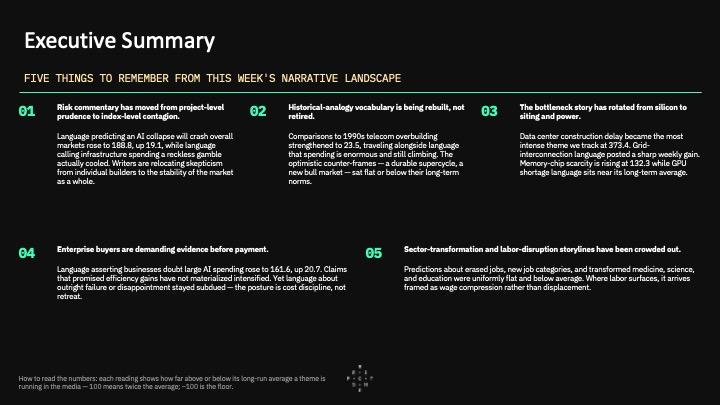
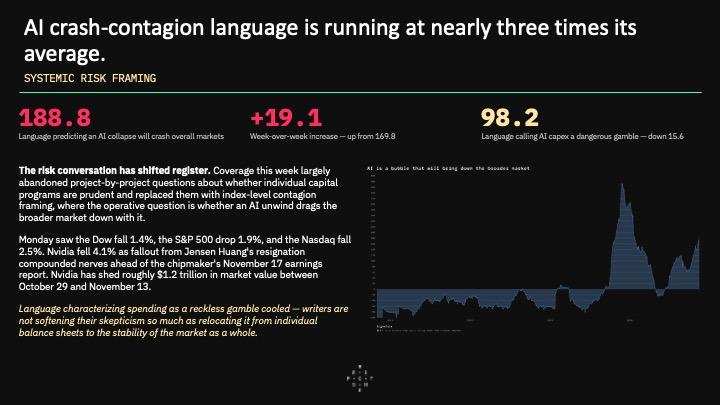
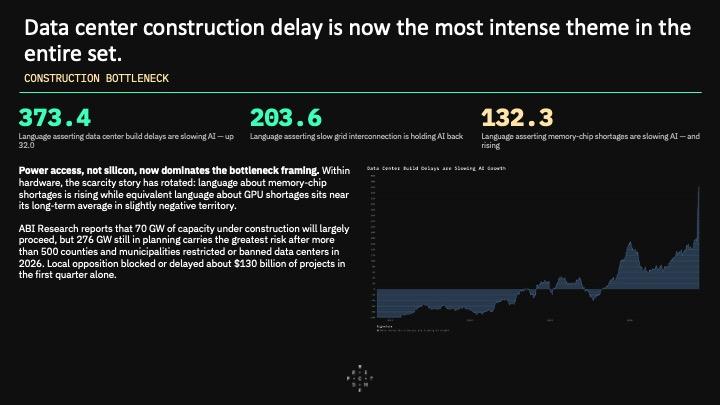
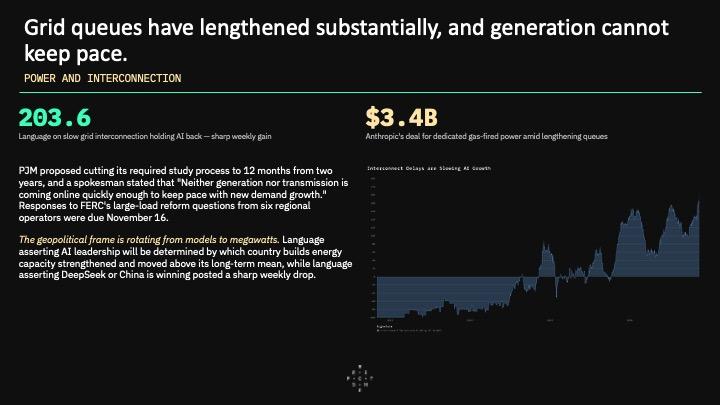
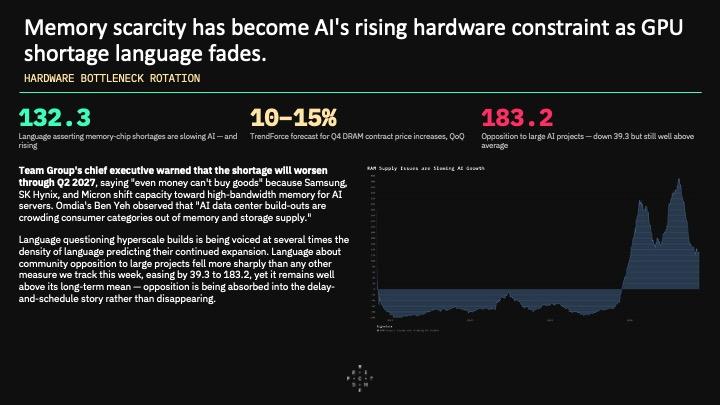
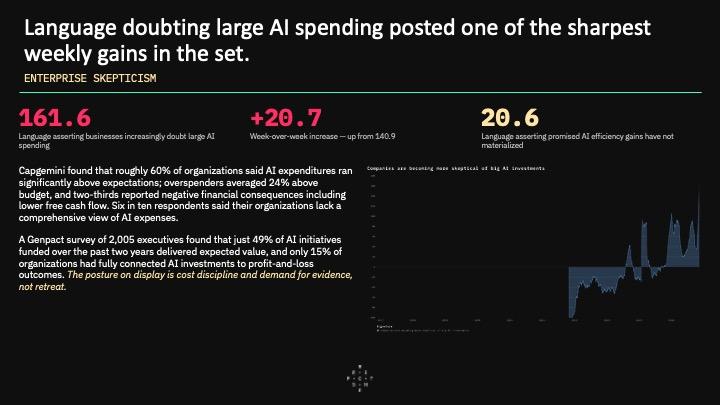
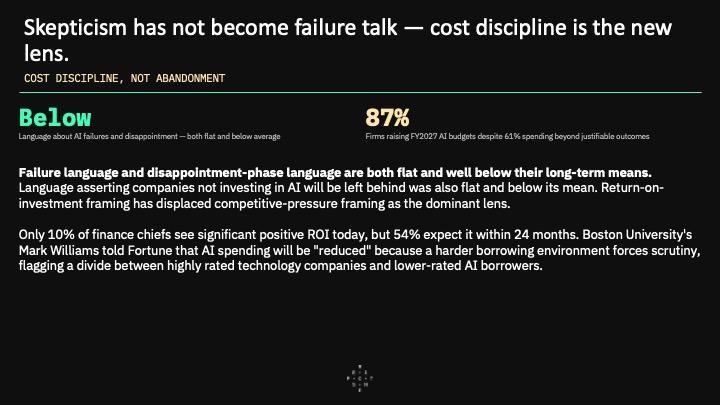
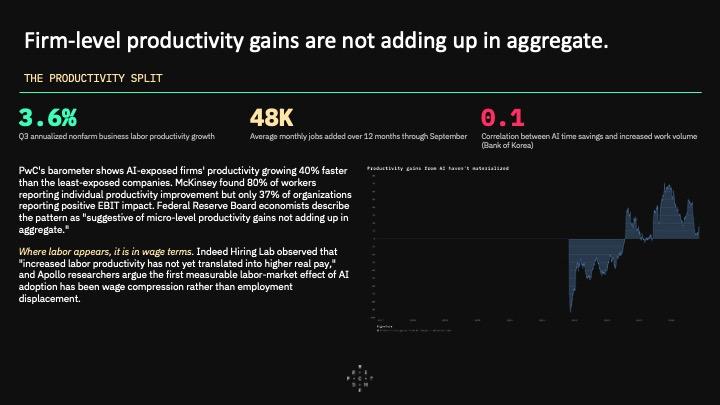
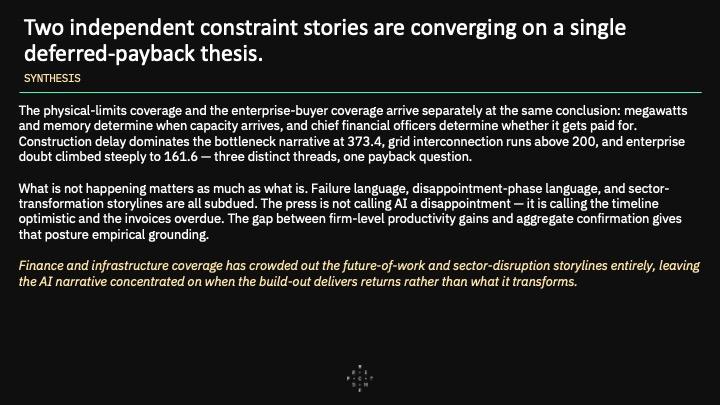
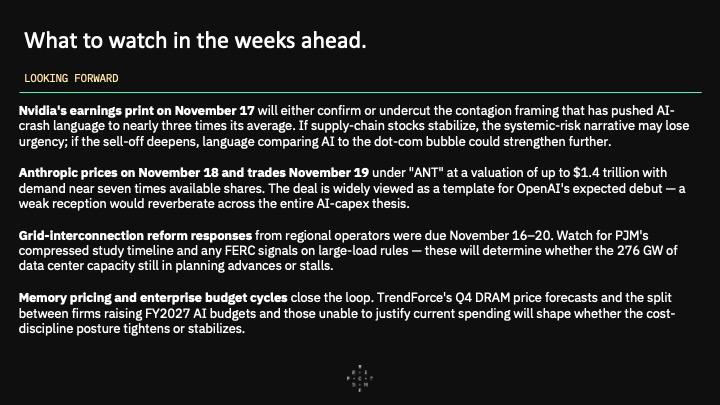
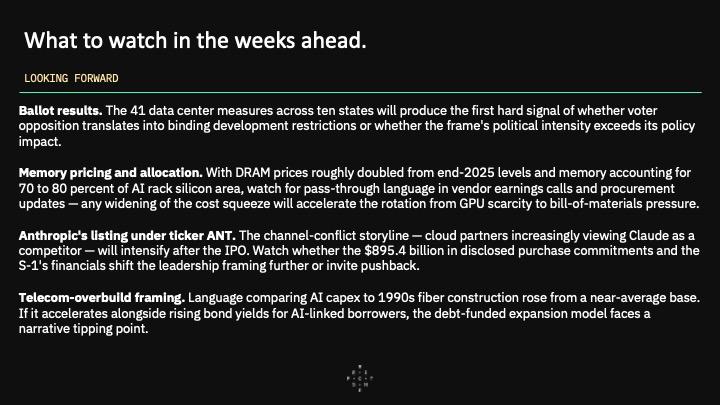
Coverage relocated the AI bottleneck from silicon to civil engineering. The density of language asserting that data center construction delays are slowing AI growth produced the single largest weekly move in our set, reinforced by intensifying coverage of grid interconnect queues, while GPU scarcity framing has effectively vanished from the constraint conversation. Memory remains the lone hardware shortage still carrying weight in the press, helped by consumer-visible price pass-throughs that keep the story in general-interest outlets rather than trade publications alone. Market commentary reframed the buildout as a financing problem rather than a technology problem. Language predicting that an AI investment collapse will crash broader markets and language asserting that businesses doubt large AI spending both strengthened sharply alongside the week's equity drawdown. Critically, the skepticism targets valuations, debt spreads, and lender appetite — not product utility; disillusionment and "corporate AI failure" framings remain subdued, and sell-side durability language held steady. Political resistance has settled in as a permanent feature of the discourse rather than an episodic spike. Language claiming that opposition to large AI investments is increasing registered the second-highest reading in our set, anchored to local ballot outcomes, incoming governors campaigning on moratoriums, and recall votes against officials who backed large projects. The three constraint stories are now a single causal chain in the press. Election results fed directly into the equity selloff, corporate pauses on uncontracted projects tied political backlash to construction slippage, and lenders began pricing community opposition as credit risk. Media is interrogating the buildout far more actively than defending it — the asymmetry between doubt-focused and expansion-focused hyperscale framing is the week's clearest pattern. The industry's benefit case is not contesting the field. Healthcare, education, labor, and competitive-urgency framings all sit at or below their norms, while language asserting that promised efficiency gains have not materialized strengthened and claims of AI reaching company profits slipped negative. The public argument is being conducted entirely on siting, power, and water terms, leaving the sector rhetorically exposed at precisely the moment when social license has become both a permitting and a financing variable.