Private Credit PulseBiweeklyNov 17, 2026
Private Credit Pulse
Next release: December 01, 2026






Next release: December 01, 2026
Coverage of private credit's push into retail and wealth-management channels has crossed from specialist trade press into mainstream financial media over the past several weeks, and the August 2025 executive order on alternatives in defined-contribution plans has supplied the policy anchor that earlier product-launch coverage lacked. Perscient's measurement shows a narrative that is accelerating rather than holding at a stable elevated level. The densest constituent theme is structural liquidity mismatch — the gap between illiquid loan portfolios and the quarterly redemption windows offered to individual investors. Commentators repeatedly reach for the 2022 non-traded REIT gating episode as their reference point, while senior managers including Apollo's Marc Rowan contest the analogy on cash-flow grounds. This is a contested narrative rather than a settled one, which is part of why it has endured. Valuation opacity and fee load operate as mutually reinforcing secondary themes rather than independent concerns. Reporting on dispersion in manager marks for identical loans feeds directly back into doubts about whether quoted redemption prices mean anything, while gross-versus-net arithmetic circulating through advisory channels frames the cost question in terms advisors can repeat to clients. Media treatment of retirement-account access reveals a split between policy permissiveness and practitioner caution. ERISA commentary emphasizes that the executive order leaves the prudence standard untouched and offers plan sponsors no litigation shield, and this legal framing has visibly dampened the enthusiasm present in product-development coverage of the same development. The smallest measured strand — rising payment-in-kind accrual and amendment activity — matters disproportionately because it supplies the potential trigger the other themes require. Absent a visible gating or stress event at a retail-facing vehicle, this body of coverage will likely settle into the low-intensity pattern typical of structural-concern reporting; a single gating episode at a prominent interval fund would connect credit deterioration, valuation doubt, and liquidity fear into one story.
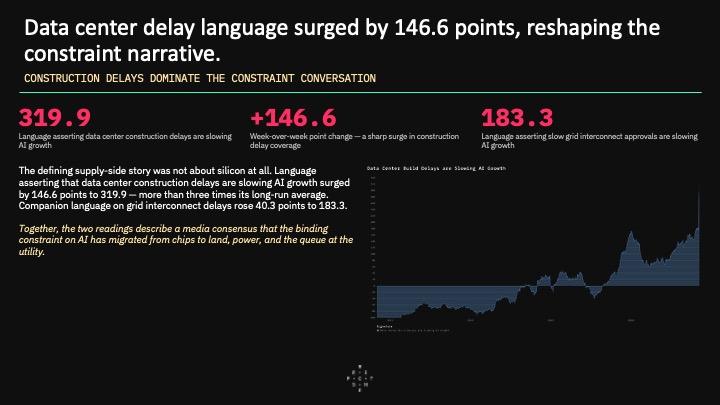
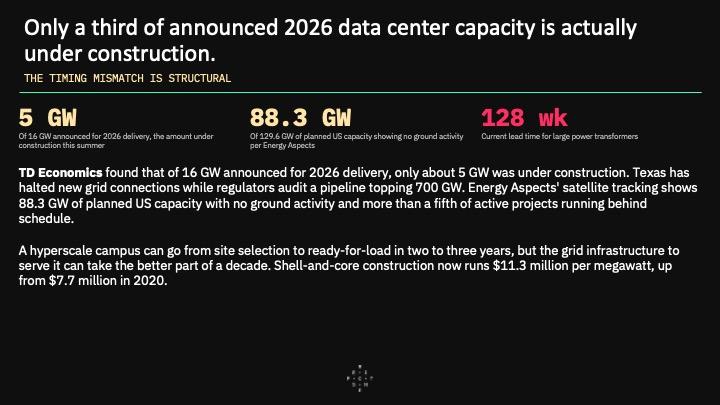
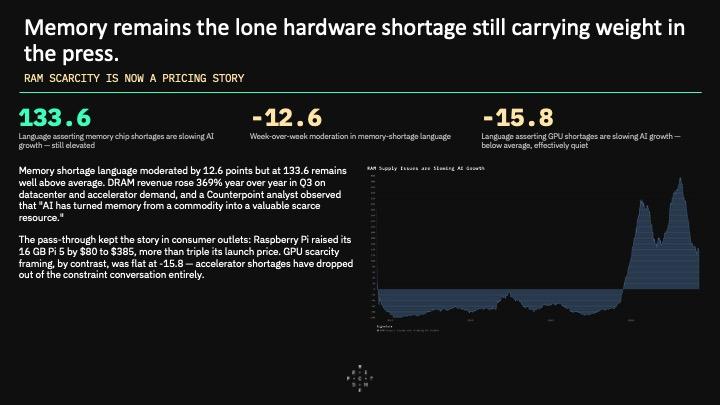
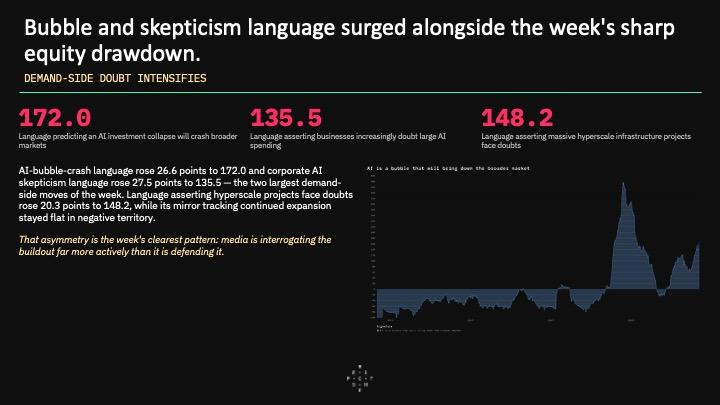
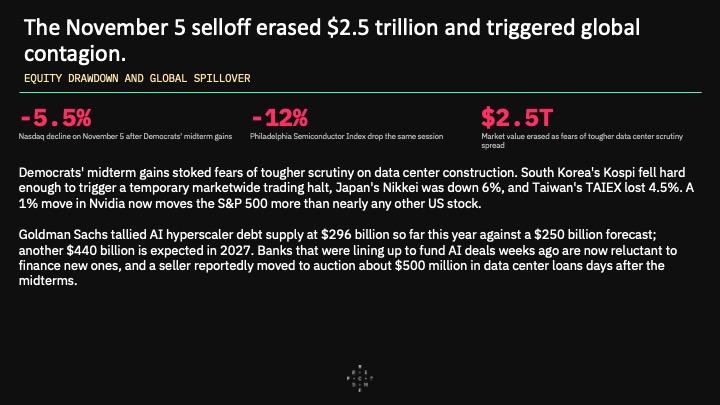
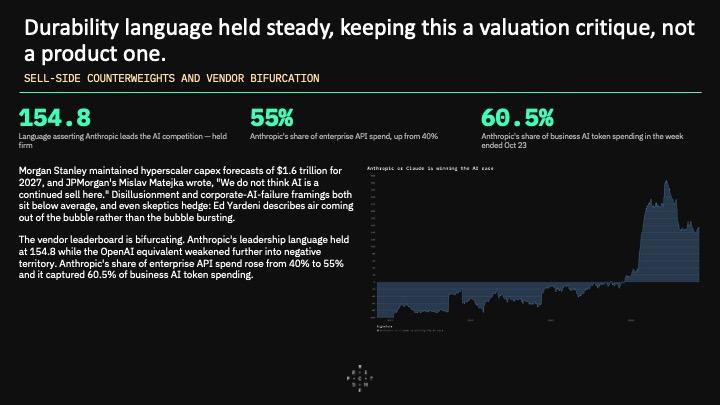
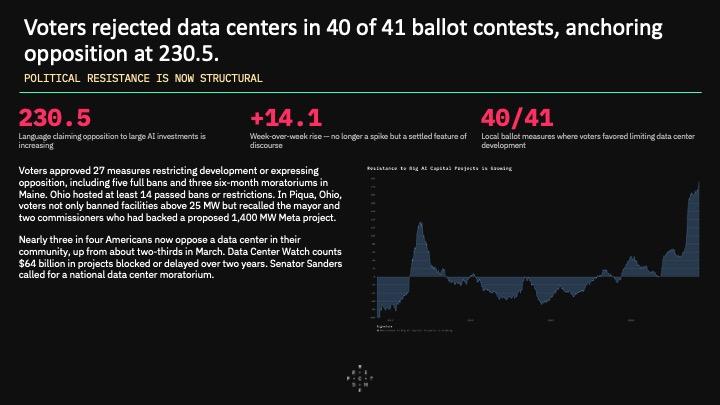
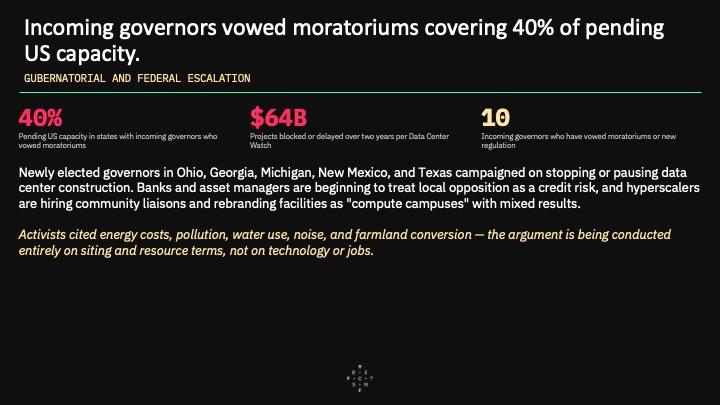
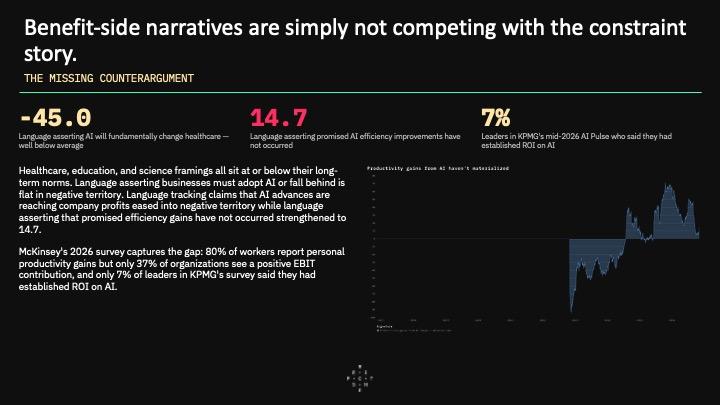
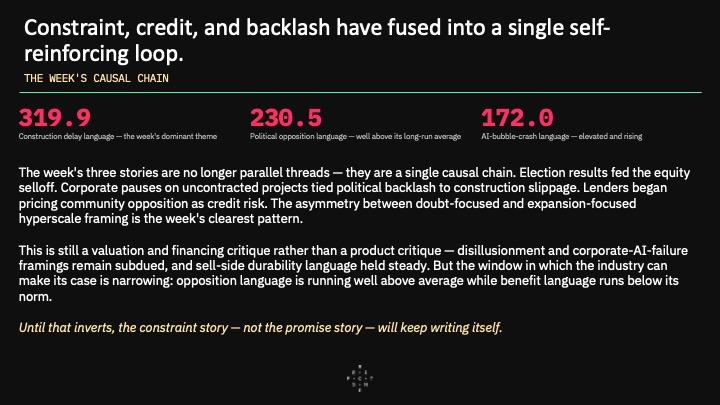
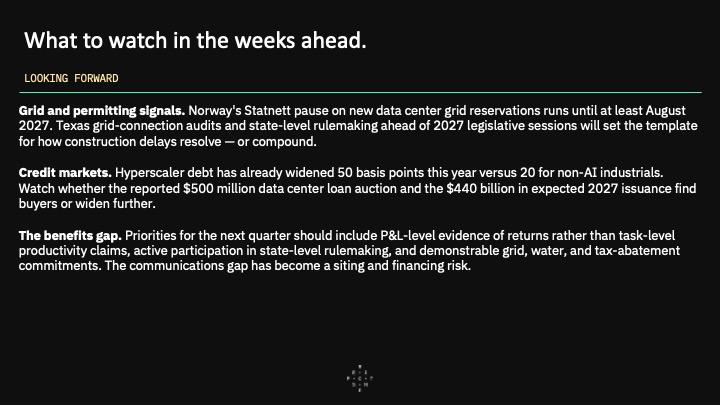
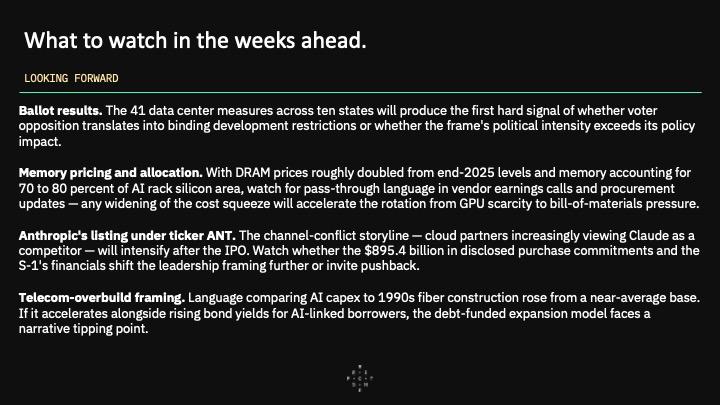
Local opposition is now the loudest frame in the set, and it has moved from rhetoric to the ballot. Coverage this week centered on 41 data center measures across ten states, 21 Ohio initiatives alone, and a steady drumbeat of municipal moratoriums from South Carolina to Minnesota to New York. The reporting increasingly frames elected officials as pricing political risk rather than courting investment — Pennsylvania's governor reversing course inside two years being the emblematic case — while capital allocators such as Larry Fink counter that siting restrictions themselves pose macroeconomic danger. The narrated bottleneck has migrated away from accelerators toward land, power, and memory. Language asserting that memory chip shortages constrain AI growth posted one of the week's sharpest increases, anchored to reporting that DRAM prices have roughly doubled since the end of 2025, while claims about GPU scarcity sat flat and below average. Grid interconnection and construction-delay framing held at an elevated plateau, and doubts about specific hyperscale projects climbed even though expectations of continued expansion did not move — a combination suggesting that skepticism is attaching to individual builds rather than to the build-out as a whole. Market coverage rotated from contagion talk toward line-item discipline. The density of language claiming that businesses doubt large AI spending produced the single largest move in the set, and framing of infrastructure spending as a dangerous gamble strengthened, while predictions of an AI-driven market-wide crash retreated meaningfully from recent highs. Supporting detail was granular rather than systemic: CFO surveys showing consumption costs overshooting budgets, absent cost-governance mechanisms, Microsoft reportedly trimming internal model spend, and credit markets charging AI-linked borrowers above 15 percent. Notably, the critique stayed financial rather than technical, since signatures tracking failed deployments, missing productivity gains, and disappointment cycles all remained subdued. Taken together, Sections 1 and 2 describe the same pressure arriving through two different doors. Voters are raising the political cost of siting at precisely the moment that investors are raising the evidentiary bar on returns, and both pressures converge on the same question put to vendors: what does this specific project cost, who absorbs the memory and power pass-through, and when does it pay back. The revival of 1990s telecom-overbuild comparisons fits that mood, implying durable assets with impaired equity returns rather than stranded capacity. Leadership framing has narrowed to one name tied to one event, while the societal debate has gone largely silent.Anthropic dominates competitor-leadership language on the strength of its S-1 disclosures, xAI's leadership framing posted the week's steepest decline, and both OpenAI and Google remained quiet. Scarcity framing meanwhile extended into training data, where restricted access to high-quality web sources is drawing fresh attention. Against this, signatures tracking job destruction, job creation, universal basic income, and most domain transformations sit well below average — leaving the jobs, education, and health conversations with unusually little media competition for any organization seeking to be heard there.