


Markets Pulse
WeeklySeptember 8, 2026

AI Pulse September 08, 2026

9.08AIPulse1.jpg
9.08AIPulse2.jpg
9.08AIPulse3.jpg
9.08AIPulse4.jpg
9.08AIPulse5.jpg
9.08AIPulse6.jpg
9.08AIPulse7.jpg
9.08AIPulse8.jpg
9.08AIPulse9.jpg
9.08AIPulse10.jpg
9.08AIPulse11.jpg
9.08AIPulse12.jpg
9.08AIPulse13.jpg
9.08AIPulse14.jpg
9.08AIPulse15.jpg
9.08AIPulse16.jpg
8.11AIPulse17.jpg
8.11AIPulse18.jpg

EXECUTIVE SUMMARY

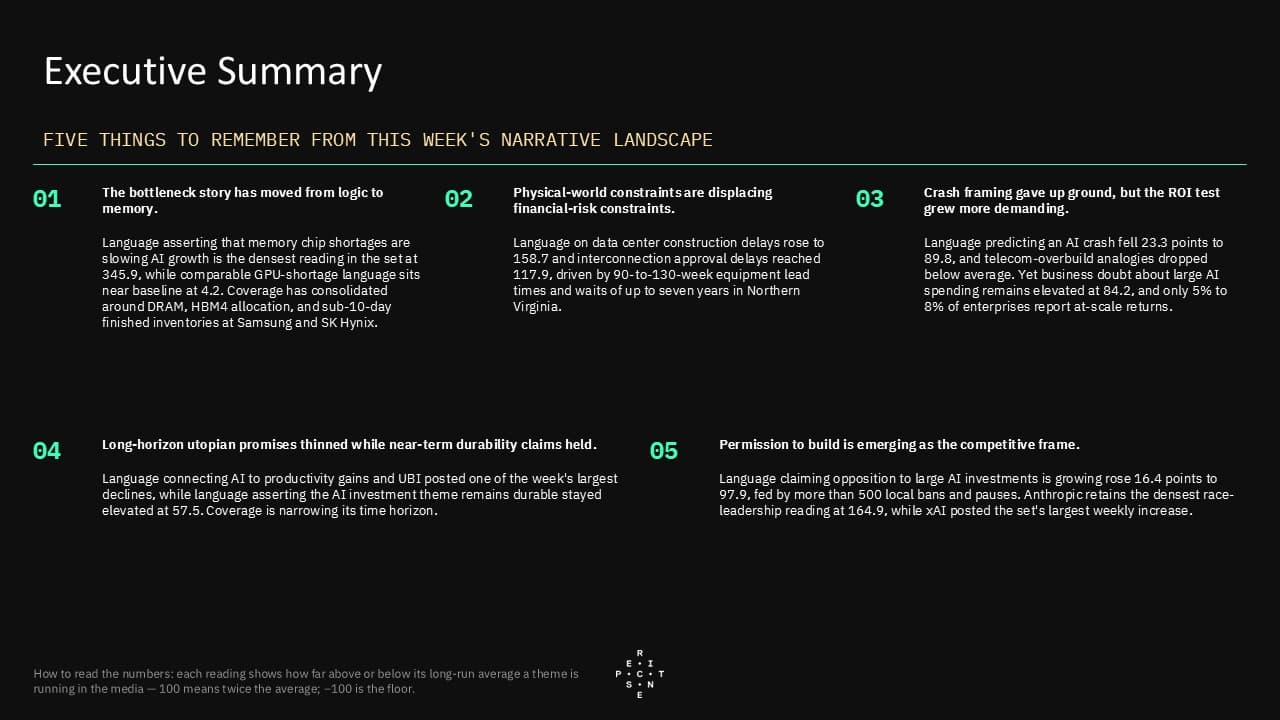
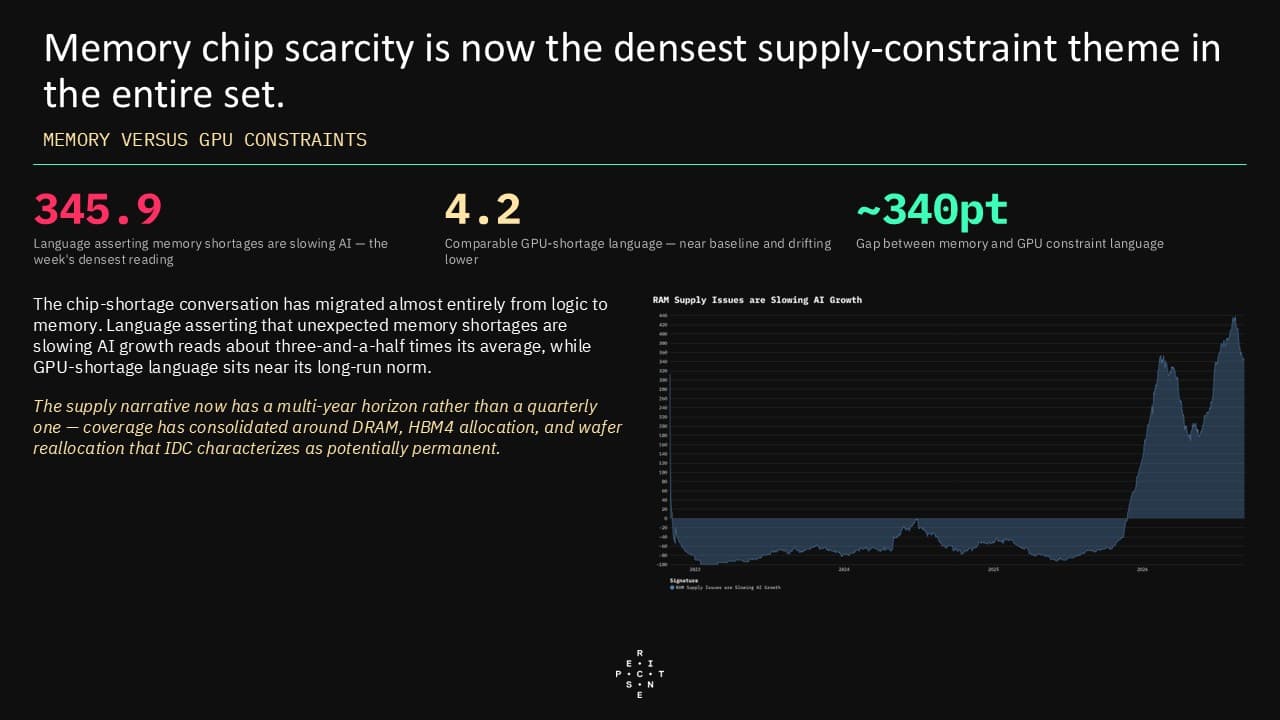
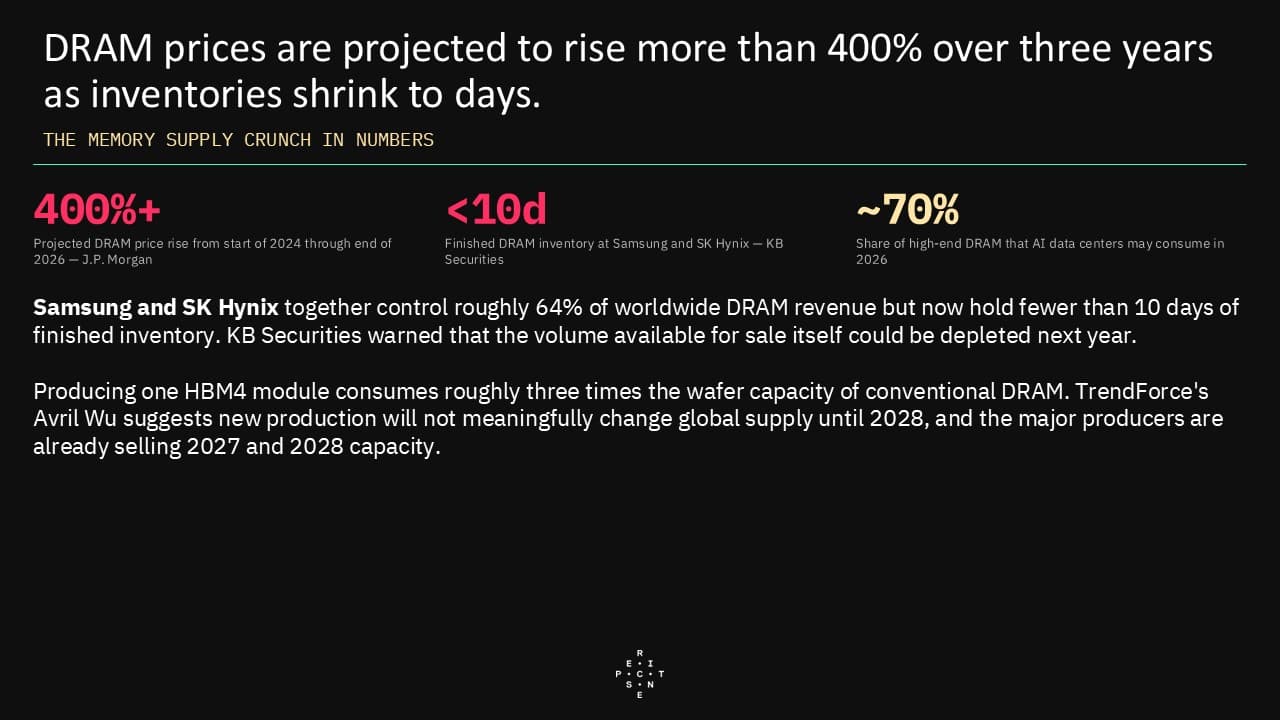
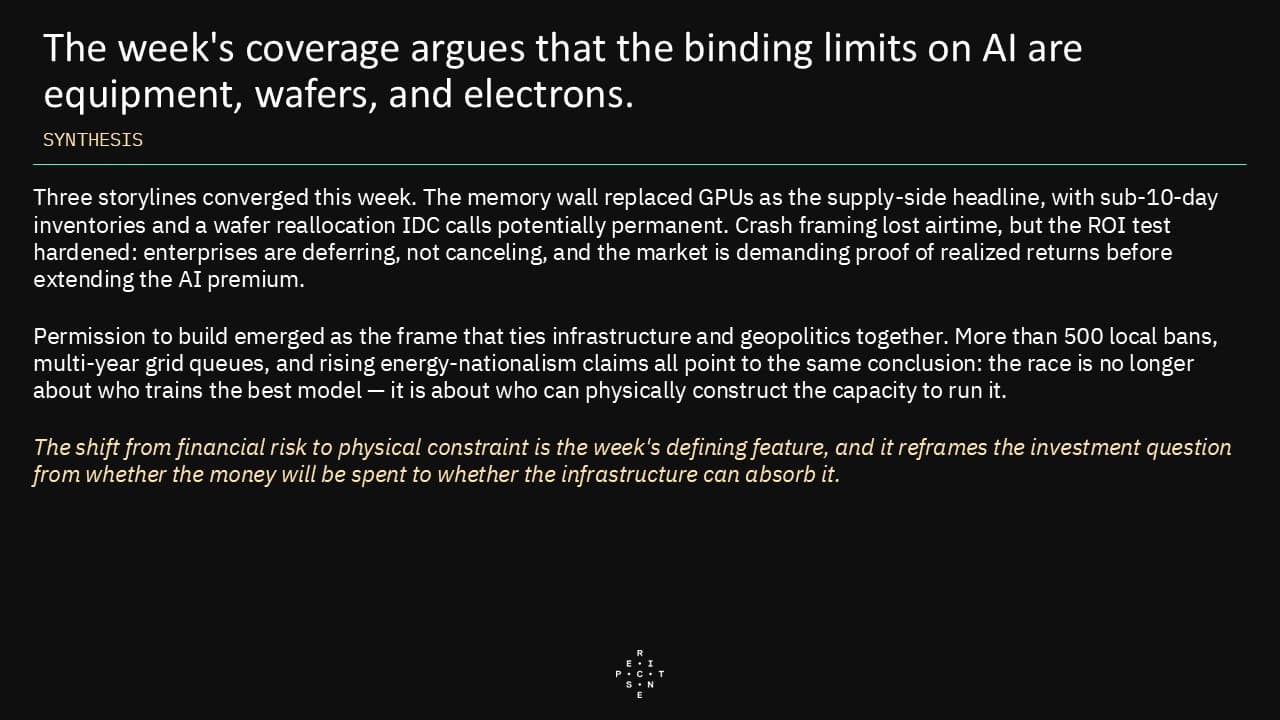
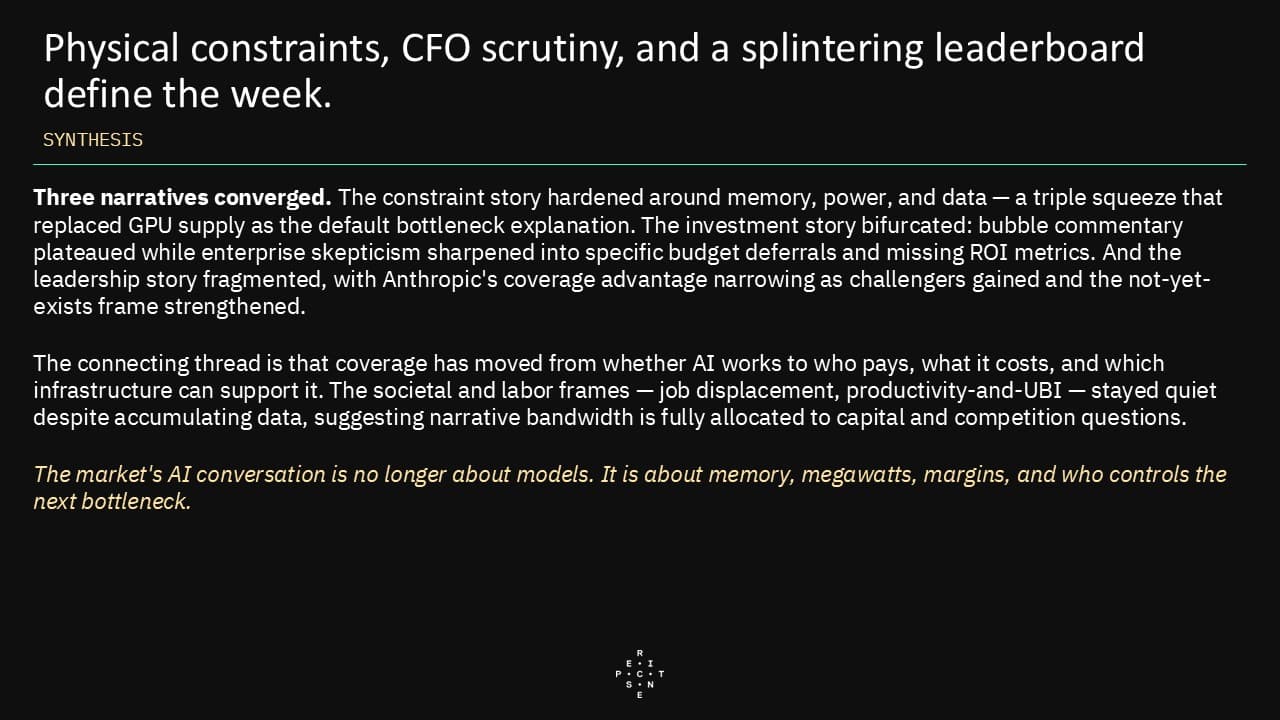
  • The bottleneck story has moved from logic to memory. Perscient's semantic signature tracking the density of language asserting that unexpected memory chip shortages are slowing AI growth is now the densest reading in the entire set, while the comparable GPU-shortage signature sits near its baseline and drifts lower. Coverage has consolidated around DRAM and HBM4 allocation, sub-10-day finished inventories at Samsung and SK Hynix, and wafer reallocation framed by IDC as potentially permanent — a supply narrative with a multi-year horizon rather than a quarterly one.
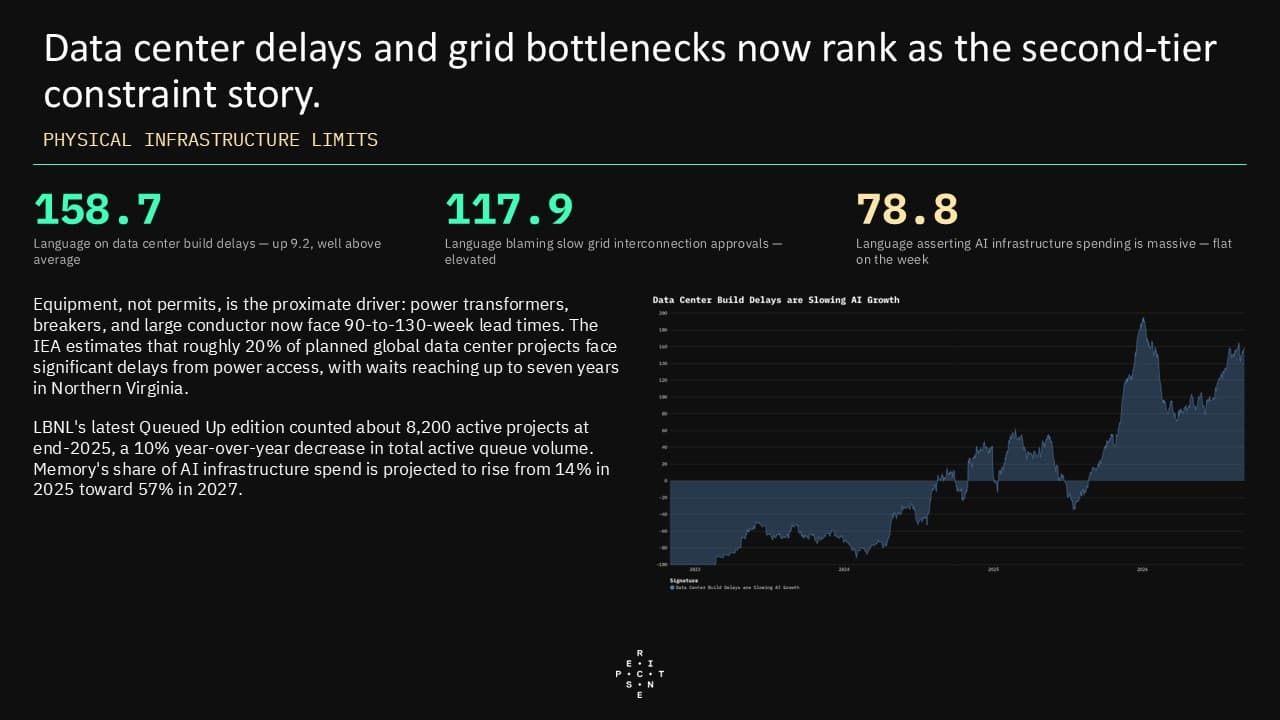
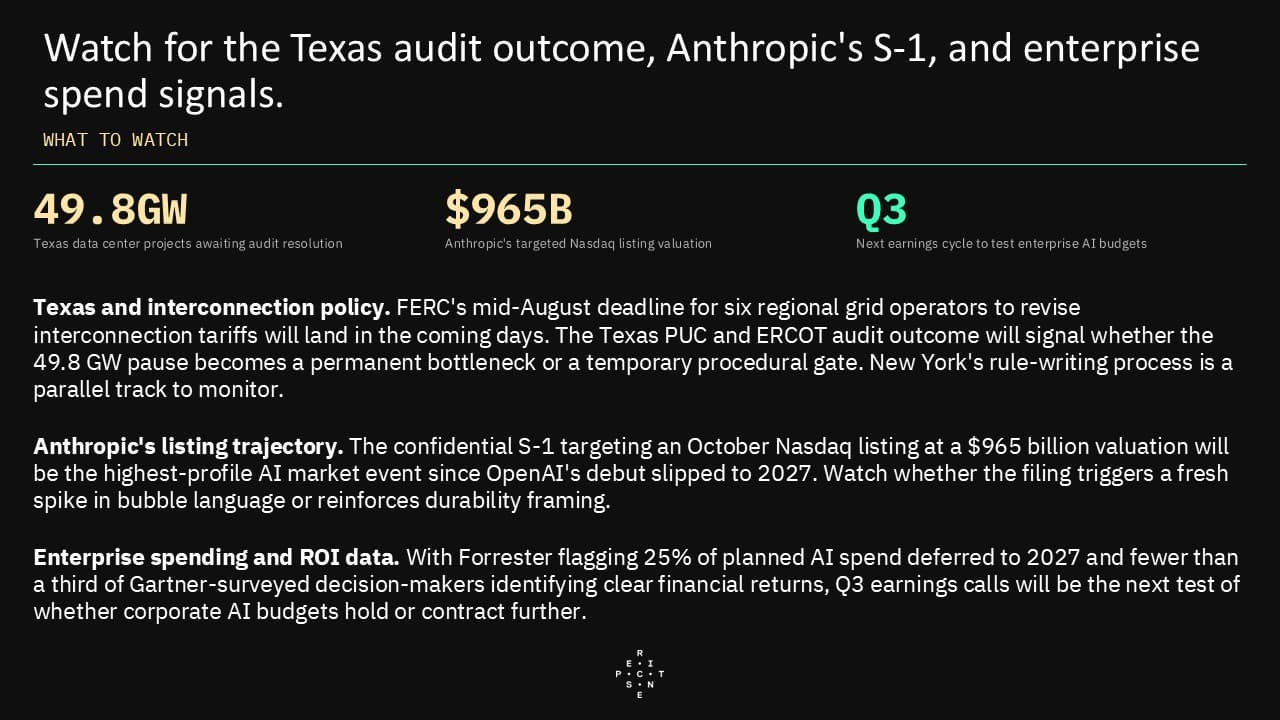
  • Physical-world constraints are displacing financial-risk constraints as the dominant explanatory frame. Signatures tracking language on data center construction delays and slow grid interconnection approvals both strengthened, driven by 90-to-130-week lead times for transformers and breakers and interconnection waits of up to seven years in Northern Virginia. Read alongside the memory story, the week's coverage argues that the binding limits on AI are equipment, wafers, and electrons — not appetite for capital.
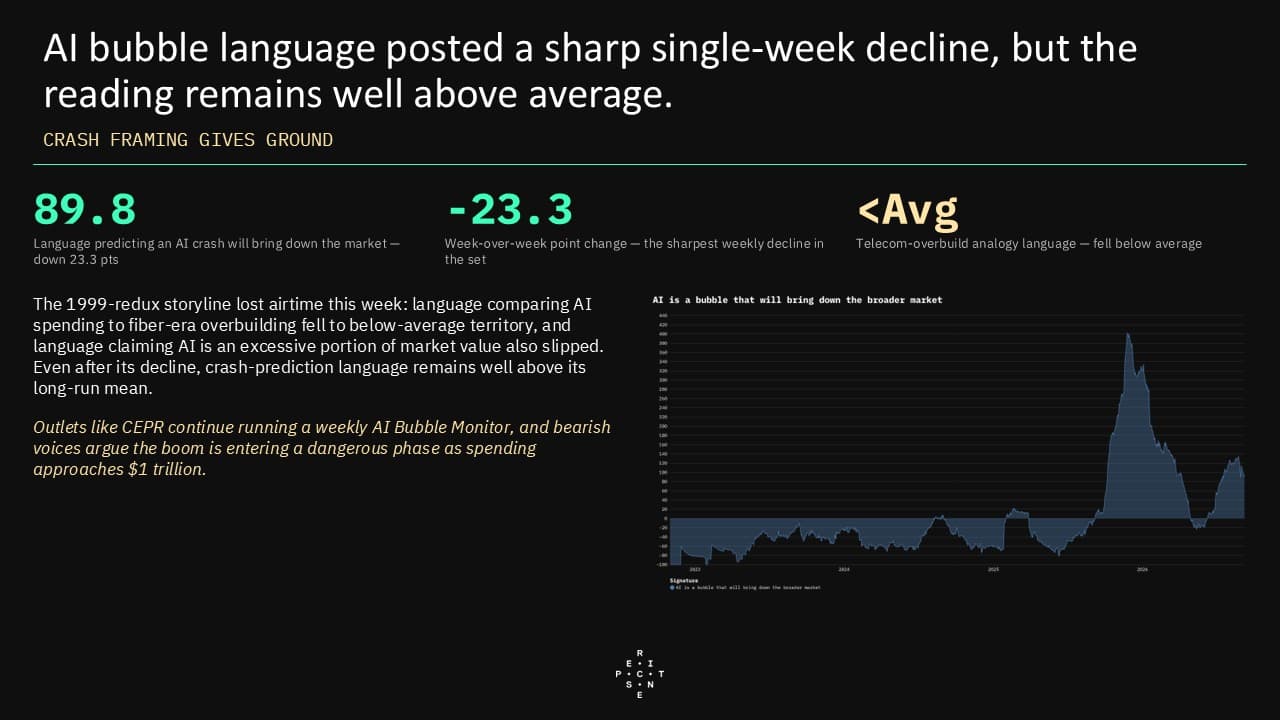
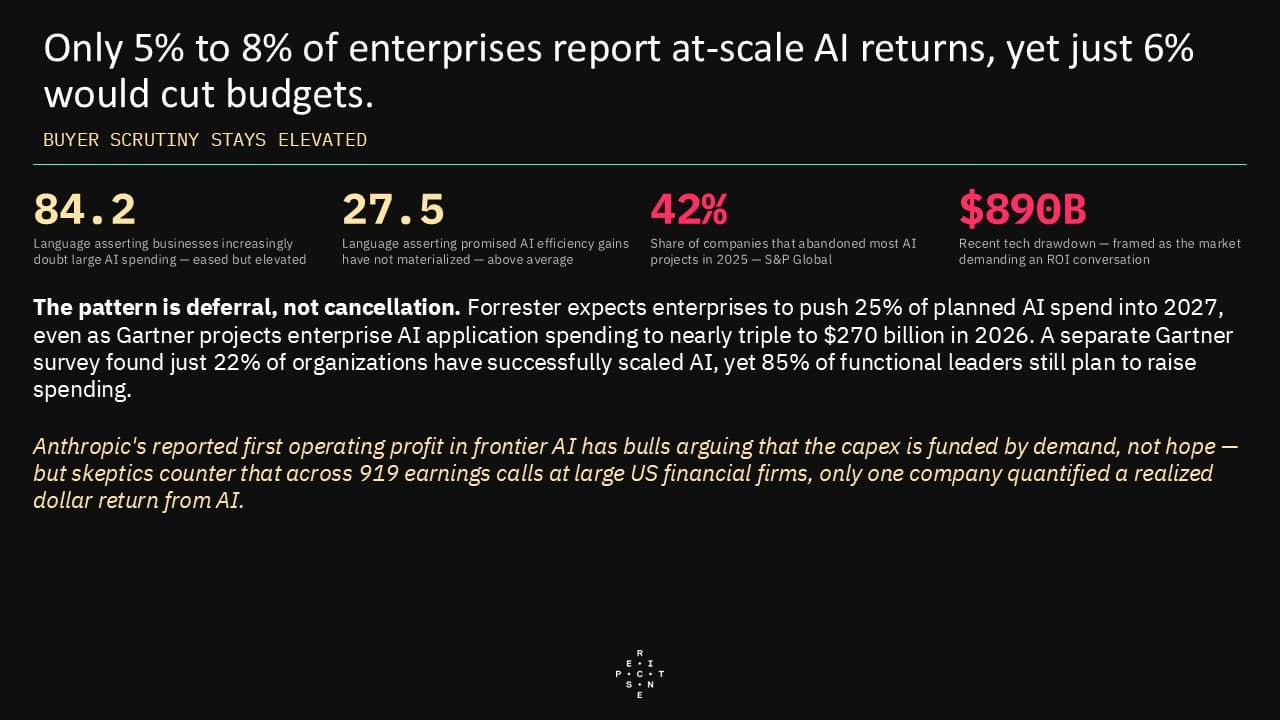
  • Crash framing gave up ground, but the return-on-investment test grew more demanding. The signature tracking predictions that an AI investment collapse will crash the market posted the sharpest weekly decline in the set, and telecom-overbuild analogies fell below average. Yet signatures tracking business doubt about large AI spending and unrealized efficiency gains remain elevated, matching survey evidence that only 5% to 8% of enterprises report at-scale returns while just 6% of executives would actually cut budgets. Media have traded the bubble-pop storyline for a deferral storyline.
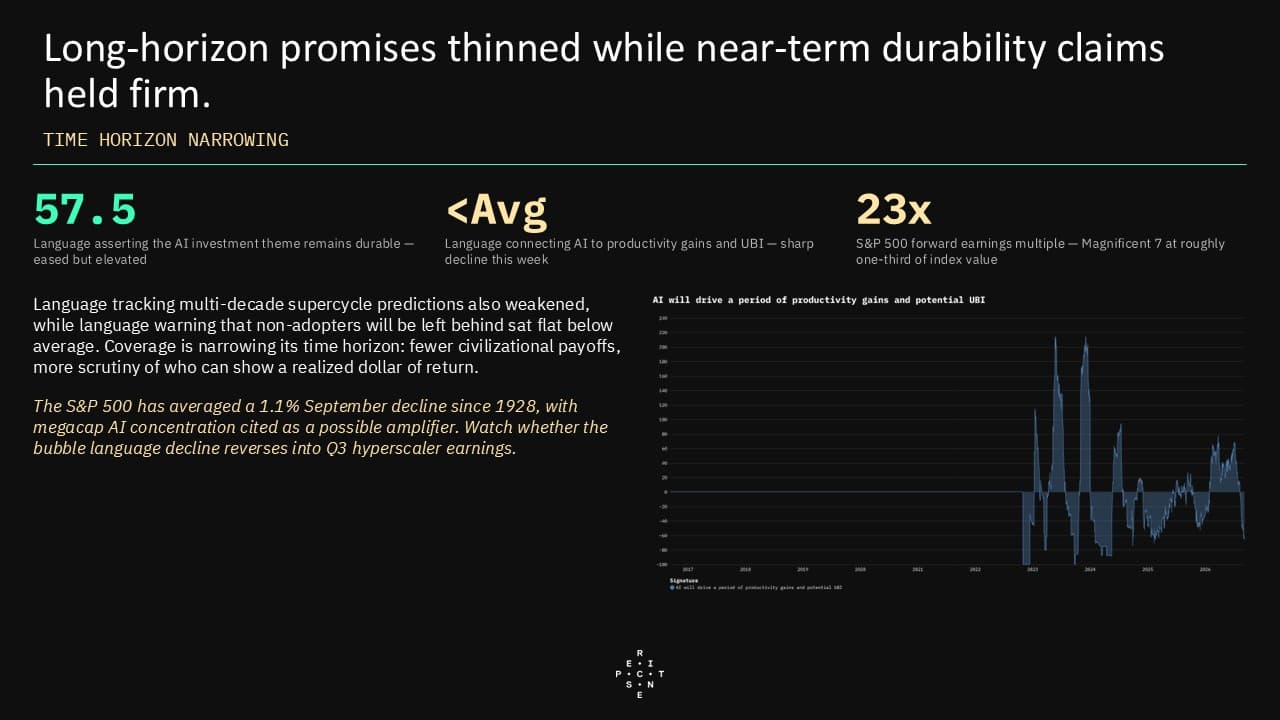
  • Long-horizon utopian promises thinned while near-term durability claims held. Language connecting AI to broad productivity gains and universal basic income posted the second-largest weekly decline, and multi-decade supercycle predictions weakened, even as the signature asserting the investment theme remains durable stayed elevated. Coverage is narrowing its time horizon: fewer civilizational payoffs, more scrutiny of who can show a realized dollar of return.
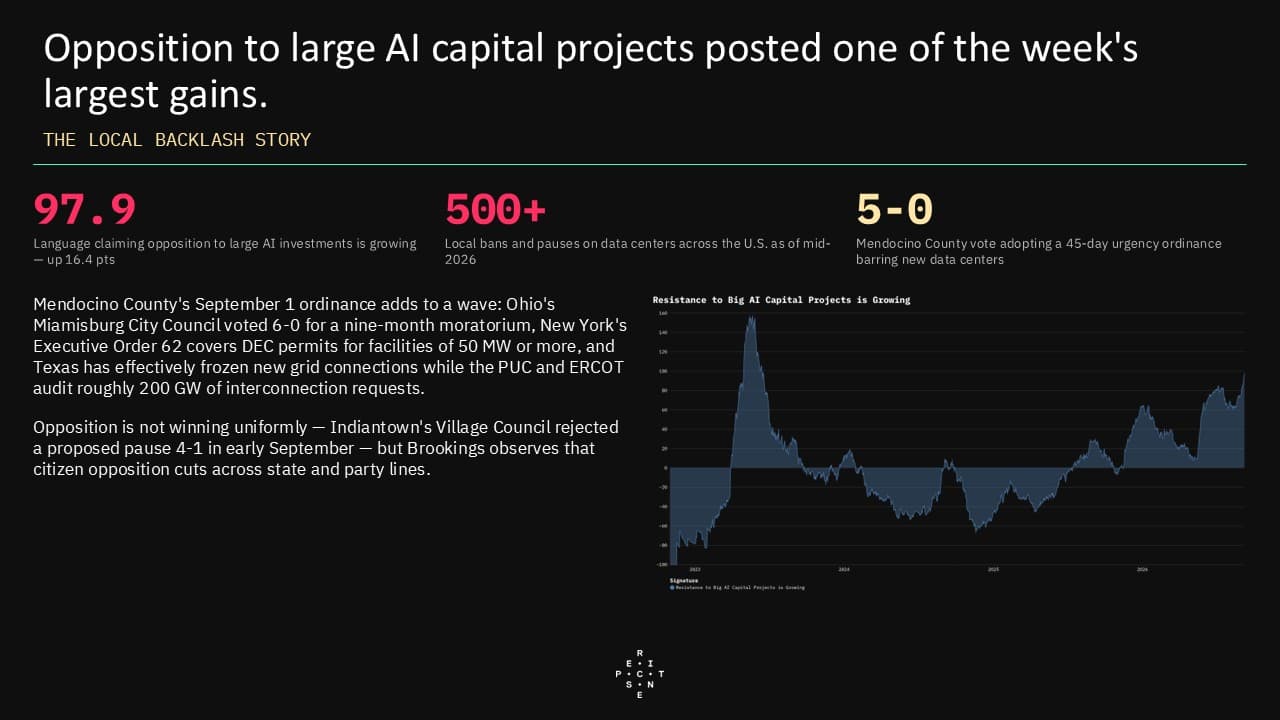
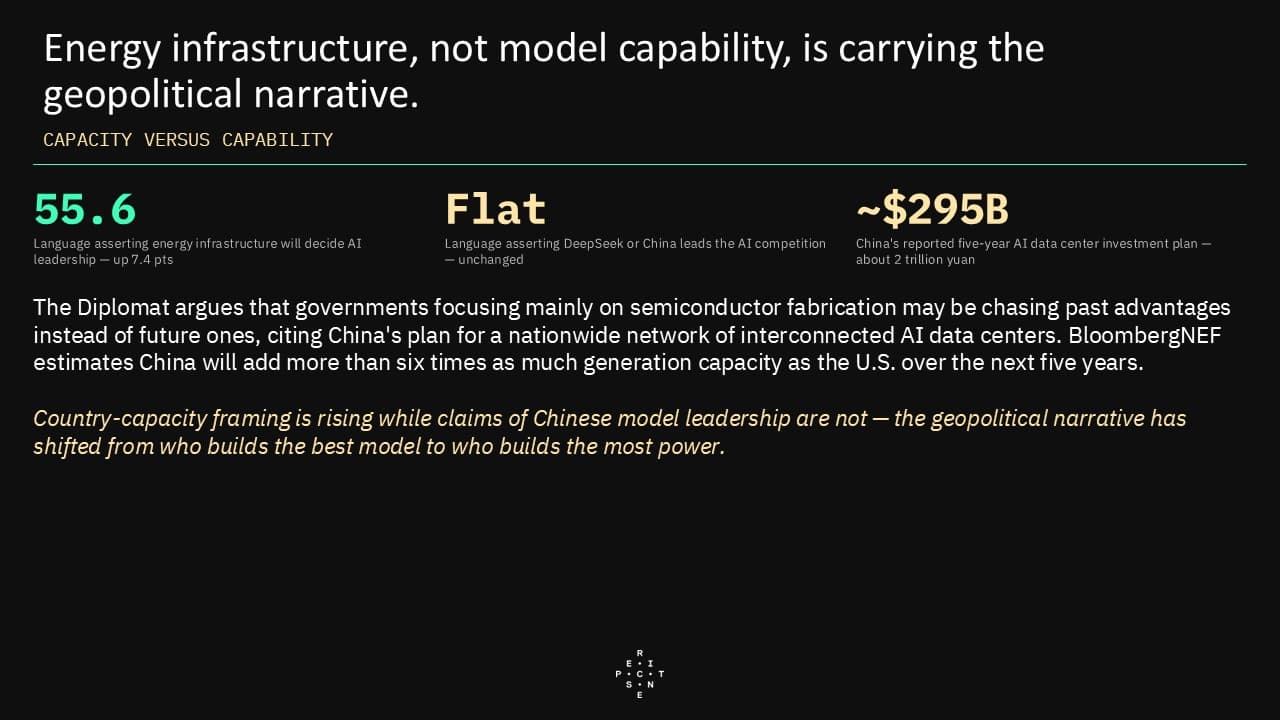
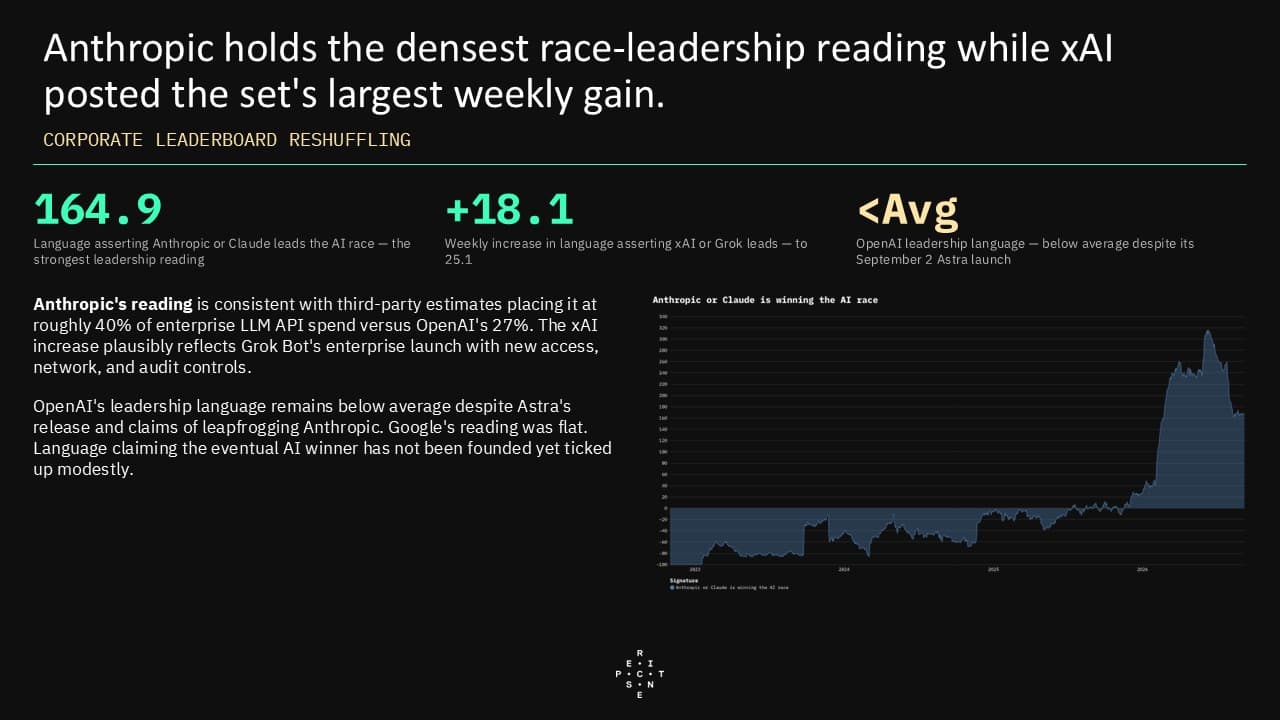
  • Permission to build is emerging as the competitive frame, and it is reshuffling the leaderboard story. The signature tracking claims that opposition to large AI investments is increasing posted one of the week's largest gains, fed by more than 500 local bans and pauses, Mendocino County's 45-day ordinance, and Texas's audit of roughly 200 GW of interconnection requests. In parallel, the signature tracking the argument that energy infrastructure will decide AI leadership rose, while claims of Chinese model leadership stayed flat — capacity, not capability, is carrying the geopolitical narrative. On corporate leadership, Anthropic retains the densest race-leadership reading, xAI posted the set's largest weekly increase following its Grok Bot enterprise launch, and OpenAI's remained below average despite its Astra release.

Recent Pulses

Markets PulseWeeklyOct 27, 2026

AI Pulse October 20, 2026

Coverage of the buildout has become a zoning-and-grid story. Language claiming that opposition to large AI investments is increasing is now the densest signature in the set, and it is compounding with language asserting that construction delays are slowing AI growth. Memphis, Aurora, Leon County and Raleigh moratoriums, plus FERC's show cause orders to all six regional grid operators, gave reporters concrete local and federal hooks. Media is framing power as a permitting and ratepayer fight rather than a geopolitical race, since the signature treating AI leadership as a contest of national energy buildout sits flat near its mean. Bubble language has hardened around financing structure and index concentration rather than around technological disappointment. Signatures tracking predictions of an AI-driven market crash and characterizations of infrastructure spending as a dangerous gamble both climbed, while language claiming that hype is giving way to disappointment stays well below its mean. The IMF's circular-deal tally, Cembalest's concentration statistics and the CoreWeave "subprime tranche" line carried the week. The specific 1990s telecom-overbuild analogy fell further below its mean, which suggests that commentators are prosecuting a credit-and-plumbing case instead of an overcapacity one. Enterprise buyers are demanding payback evidence without renouncing the technology. Language asserting that businesses increasingly doubt large AI spending posted the single largest weekly increase in the file, yet signatures claiming failed corporate initiatives or absent efficiency gains remain near or below their means, and the signature tracking AI's translation into company profits firmed. Gartner's finding that only 13% of CIOs report meaningful value, alongside Citi and Bank of America quantifying returns, shows coverage centered on governance and accountability rather than abandonment. The market payoff question and the boardroom payoff question are now the same story told to two audiences. Investors interrogating returns on capital expenditure and CIOs interrogating total cost of ownership draw on the identical evidentiary frame, which explains why systemic-contagion language and buyer-doubt language rose together while the supercycle rebuttal also strengthened. Fear-of-missing-out messaging is not landing; the signature claiming that companies must adopt AI or fail competitively stayed flat below its mean. Media's vendor leaderboard has collapsed to a single name while input constraints define the broader frame. Language asserting Anthropic's leadership stands far ahead of the OpenAI and Google equivalents, boosted by IPO anticipation and quarterly revenue reporting, while the xAI leadership signature recorded the largest weekly decline despite an active shipping cadence. Combined with rising language on training-data scarcity and the land, power and memory constraints of Section 1, the week's dominant frame moved from what AI can do toward what AI can obtain.

Private Credit PulseBiweeklyOct 20, 2026

Private Credit Pulse

Next release: November 03, 2026

Private Credit PulseBiweeklyOct 20, 2026

Private Credit Pulse October 06, 2026

The dominant frame has been rebuilt from growth to pressure. Coverage that once treated private credit as a yield story filling the void left by bank retrenchment now organizes itself around refinancing obligations, deferred cash interest, and redemption mechanics. Perscient's Semantic Signature tracking this cluster has become considerably denser over the trailing ninety days, and the movement comes primarily from the speed at which the pressure framing has reached outlets that previously covered the asset class through a returns lens. The maturity wall has acquired both a number and a harder vocabulary. Reporting has attached a circulating range of refinancing figures to a story that previously lacked a numerical anchor, and it has moved from aggregate exposure toward borrower-level distress in specific sectors and vintages. Pressure-framing terms such as "wall," "cliff," and "crunch" have displaced neutral descriptors at roughly double their prior rate across both trade and mainstream outlets. Payment-in-kind has been converted from a credit structure into a diagnostic test, and it is spreading faster than the story that contains it. The density of language presenting PIK income ratios as evidence of concealed distress now exceeds that of the parent maturity-wall framing, which is characteristic of frames offering a single number purportedly revealing hidden deterioration. This sub-narrative has escaped its specialist origins and appears in outlets that do not ordinarily engage with credit mechanics. The three components function together as a reusable template rather than as separate arguments. Maturity wall, PIK accumulation, and the redemption mismatch at semi-liquid retail vehicles are deployed in consistent sequence, supported by an antagonist structure in which retail investors and distribution channels occupy identifiable roles and regulatory examination priorities are cited as validation. Source diversity has widened from credit trade press and sell-side research into general business, policy, and consumer-facing media, an expansion that typically precedes either regulatory action or a market event confirming the frame. The managers' rebuttal is not gaining ground, which compounds the durability problem. Perscient's measurement of the counter-narrative articulated by the largest alternative managers remains well below the pressure narrative and has been flat across the window, reflecting the harder rhetorical position of explaining why apparent warning signs are benign. Combined with the measured rather than alarmist tone of the pressure coverage, this asymmetry suggests the frame will persist through multiple news cycles, with contrary data points absorbed as exceptions rather than treated as refutation.